
Syria’s anti-money laundering dilemma
With a blank slate for implementing financial crime laws, Damascus should develop a system that works
© syriaintransition.com
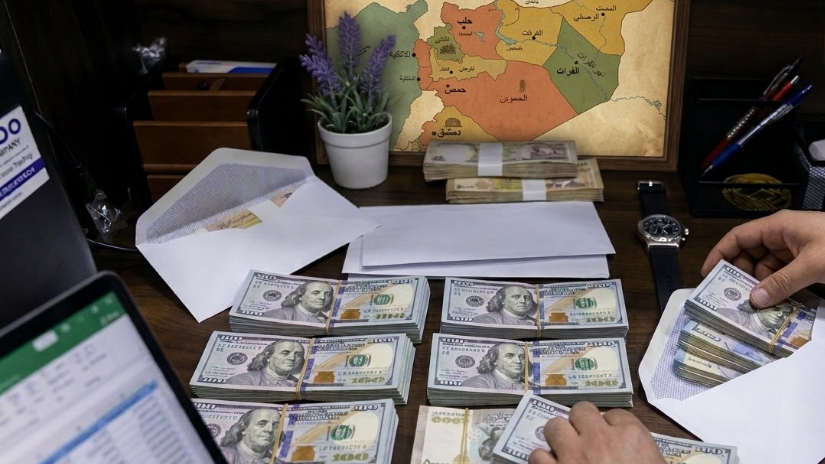
To reintegrate with the international financial system Syria has to implement a technically rigorous anti-money laundering (AML) regime. Grey-listed by global standard setter the Financial Action Task Force (FATF) in 2010, and with multilateral sanctions imposed on the Assad regime during the war, Syria was effectively cut off from the latest developments in AML, including access to regulatory technology (regtech).
With Syria starting its AML regime essentially from scratch, the public and private sectors will have to invest huge amounts of resources to get its wider financial crime compliance up to par. While Syria has no choice but to follow international diktats, it should not uncritically adopt a tick-box approach to economic crime that comes at great implementation cost with minimal results. As FATF itself notes: “countries intercept and recover less than one percent of global illicit financial flows”.
Syria has an opportunity to improve on the system as its builds the foundations by leveraging international expertise and focusing on policies that can reduce economic crime. These are pressing challenges. As the country gets more intertwined with the global financial system the more it will expose itself to global financial crime trends, particularly the surge in digitally enabled fraud, which is estimated at US$500 billion in annual global losses.
The situation
While sanctions have been eased, Syria is still considered a high risk jurisdiction and therefore not fully open for international business. To meet expectations, Syria needs to implement FATF standards at the governmental and private sector levels – from overhauling the financial intelligence unit (FIU) at the central bank, to developing the competencies of financial crime professionals at the judiciary and in law enforcement. It also requires building compliance capacity across financial and non-financial sectors, from banks and money exchangers to lawyers and insurance companies, real estate agents and dealers in precious stones and jewelry.
Syria has until January 2028 to implement a comprehensive AML regime ahead of an evaluation by regional body MENA-FATF, with the final report to be discussed at a global FATF plenary in 2029, that will then determine whether Syria gets off or stays on the grey-list. Given the amount of work to be done to meet FATF’s technical requirements, Syria is expected to stay on the grey-list into the 2030s.
While the public sector is being supported by the World Bank, the International Monetary Fund and other bodies in capacity building and developing the National Strategy for Countering Money Laundering, Terrorist Financing, and Proliferation Financing, the state will at some point in the near future have to fully fund the operations of its AML programme.
As for the private sector, it has been left scrambling to catch up. Syrian banks are so far behind their global peers that many compliance departments are manually screening sanctions lists on Excel spreadsheets and even using pirated versions of Microsoft. To turn this around, financial services firms face high costs to implement a AML regime, from acquiring the regtech to hiring and training human resources.
Crucially, the current lack of AML controls is hindering Syrian banks’ ability to establish relations with foreign correspondent banks to carry out transactions, as respondent banks, particularly in North America and Europe, have high requirements due to their low risk appetite. Syrian institutions are however struggling to access regtech and AML software due to the hangover from sanctions; the very core banking systems needed to have a AML regime in place and to interact worldwide.
The argument
AML compliance has become a gargantuan $200 billion-plus a year financial services industry in the two decades since the USA pushed the adoption of AML and countering the financing of terrorism in the wake of the 2001 attacks. Yet in preventing money laundering the results are negligible – less than 1 percent of illicit funds are seized worldwide.
A major problem with the whole AML ecosystem is that governments have essentially outsourced financial crime detection to the private sector, which is what Syria is being forced to do. While the private sector should play a role in preventing crime – know your customer (KYC) checks and enhanced due diligence on riskier clients – they are not the police.
At the country level, the UK is a good example of the high costs, low yields, as it is supposedly at the global forefront of AML activity. It spends some US$44.48 billion a year on compliance activity – more than double the size of the Syrian economy. That amount is equivalent to around 1 percent of the UK’s GDP, yet anywhere between $130 billion to $425 billion is laundered through the country a year, while less than 1 percent of illicit funds are intercepted. Adding further insult to injury, fewer than 3 percent of the Suspicious Activity Reports (SARs) filed by private sector institutions to the FIU are of any value to law enforcement investigations.
By such measures the system is not fit for purpose. It has become a tick-box exercise to be compliant with the rules and not fall foul of the regulator, overly focused on technical compliance and throughput, such as filing SARs about clients, rather than stopping nefarious activity. It has led to a “busy work” culture that obscures real outcomes.
For instance, the pressure on the private sector to file SARs, also known as suspicious transaction reports, has led to defensive filing – send the financial intelligence unit anything that looks suspicious. This has led to 85 to 95 percent of SARs being false positives, so not genuine financial crime risk. The FIU however needs to sift through these SARs, which in the case of the UK run to over 800,000 a year, to determine any actionable leads that can be passed on to law enforcement that can in turn result in prosecutions.
While the quality of SARs can be improved to reduce false positives, financial intelligence can only be acted on if the government has the resources to act. But governments are not matching the spending of the private sector in human resources or technology. To use the UK again as an example, only an estimated 0.042 percent of GDP (approximately $1.1 billion annually) goes on fighting economic crime, and less than 1 percent of police resources. No wonder less than 1 percent of illicit funds are intercepted and fraud now accounts for 45 percent of all crime in England and Wales.
Unsurprisingly, there are growing calls for an overhaul of the system, including by Oliver Bullough in his recent groundbreaking book Everybody Loves Our Dollars – How Money Laundering Won.
The implication
The implication of adopting the current AML system is that the Syrian private sector will have to potentially spend the equivalent of 1 percent of the country’s GDP, around $200 million a year, to implement policies that are ineffective. Furthermore, the ailing Syrian banking sector cannot afford to shell out such amounts for AML – total banking sector assets are around $4 billion, so banks would have to spend around 5 percent of total assets on AML compliance. More concretely, it is estimated that around 15 percent of a financial services firm’s operating costs are spent on risk and compliance activities.
The regtech is one of the biggest expenditures. For a bank to access a commercial enterprise-grade sanctions screening software system costs in the range of half a million dollars, while a five-year licenced package can cost between $2.5 million to $4 million. The bank will then have to tailor that system, as well as acquire further software and services at additional cost, while also needing external consultants and advisors to implement the systems.
In an ironic reversal of the usual sales pitch, Syrian banks now find themselves courting the very international software vendors that consider Syria too risky and its market too small to be worth their attention.
But no matter how much the private sector is forced to spend on AML, it can only be effective if the state provides adequate resources to law enforcement and is proactively going after criminals. As the donor funding for financial reform and capacity building will dry up in the coming years, Damascus is going to have to foot the bill for enforcing AML. It should consider its longer term approach: how it will fund policies, and where it can assist the private sector in having an effective policy.
What's next?
Syrian institutions need to weigh their options carefully, and not just try to acquire top shelf regtech that is one-size-fits all and what foreign correspondent banks wants. Systems can be tailored to Syria’s needs, and budgets. There is a lot of regtech out there, and Syrian private and public sectors should not be sold snake oil.
The central bank could better assist reporting entities by guiding them on what systems to acquire, and by supporting institutions that want to try alternative regtech that may be better suited to Syria’s operating environment. There are many AML veterans out there – including Syrian expatriates – that may be willing to assist and provide advice on what works and what does not.
Law enforcement and AML compliance veterans have for instance pointed out numerous ways to improve effectiveness, including re-adopting policies that had worked in the past such as cash seizures and asset forfeitures, to using undercover agents to disrupt organised crime gangs.
At the private sector level, veterans suggest that AML compliance officers should act less like straight-jacketed session musicians – just reading the music score – and be allowed to be jazz musicians, to use the score – the rules – but go beyond what is required and have the creativity to monitor and spot criminal activity. This is a particularly pertinent point as a further drawback of the AML system is that compliance departments are using money laundering typologies based on past activities while criminals are continuously adapting their modus operandi.
Critics have also called for senior banking figures to be held accountable for AML compliance failures rather than the regulator imposing fines, which are paid for by shareholders. The enablers of financial crime, such as accountants and lawyers, should also be a particular focus, as without these intermediaries, professional money launderers struggle to carry out their activities.
To improve overall effectiveness the central bank should consider the above recommendations, as well as develop a strong public-private partnership to enable an environment of information sharing, support and trust. This is needed beyond the AML compliance realm, as the country’s flailing banks need to regain the trust of the public. A strong financial sector that is not a haven for dirty money and that protects clients from economic crime would go some way to rebuilding trust.
Counter fraud is a particular area in which the banks and the government can show they are serious about disrupting economic crime. It could also be an easy ‘win’ with the public. While money laundering may be an abstract crime for many, being a victim of fraud increasingly is not. As noted, in the UK fraud now accounts for 45 percent of all crime, and it is expected to be increasingly prevalent in Syria as the economy deepens its international links. Syria can also get ahead of the curve by giving particular focus to anti-fraud measures, which only this year became a focus for FATF, to combine fraud and AML, known as FRAML.
Syria cannot push-back much against the global AML system of course, especially as it does not have the luxury or largess to fully develop a system of its own. However, Syrian institutions can think critically about how to make AML more effective, not being encumbered as other jurisdictions are by AML legacy systems, institutionalisation and a powerful financial services sector.
An effective system would also improve Syria’s reputation in a neighbourhood not short on financial crime – Iraq’s heist of the century and recent corruption scandals, Turkey currently dealing with a $20 billion “Fonzi” scheme, and Lebanon’s protracted financial crisis, which was also a Ponzi scheme of sorts. Each of these countries followed the international AML playsheet, but lacked the political will to achieve something more tangible. Syria should not squander its chances and be hampered by an expensive AML system that pleases international counterparts but does not actually reduce financial crimes.