Guided freedom
How foreign journalists can - or cannot - work in Syria
As Damascus celebrates a jump in its World Press Freedom Index ranking, foreign journalists describe an accreditation system that remains opaque and quietly encourages self-censorship.
On the ground in Syria, there is generally a tangible sense of freedom that did not exist under the Assad regime. The disappearance of the notorious intelligence agencies and the cult of personality have made locals more willing to speak with candour to outsiders. Foreign journalists are no longer routinely accompanied by government minders or forced to worry about hotel rooms being bugged or devices being tampered with.
But this new freedom is fragile – as evidenced by the procedures through which foreign journalists obtain permits to enter and operate in Syria. In some respects, these procedures echo practices from the previous era.
Access as a filter
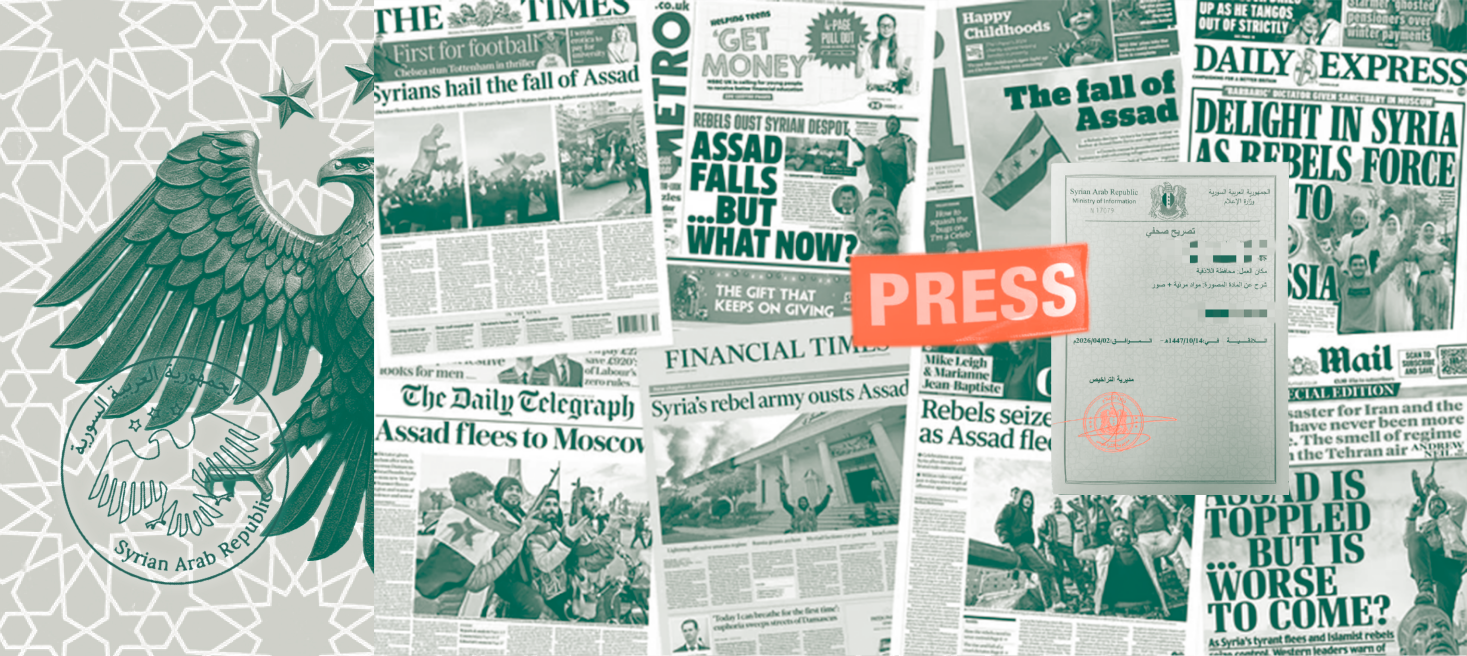
The process of entering Syria still hinges on a distinction inherited from the Assad era: entering as a visitor versus entering as a journalist. Officially, the latter requires the foreign journalist to obtain permission from the Ministry of Information's Foreign Media Directorate prior to entering the country. Presently, applications are submitted via an online portal of this directorate and are deemed valid only if submitted from outside Syria. In practice, this means journalists cannot enter on a visitor visa and then seek accreditation when there.
The application itself is complex. Journalists must provide personal details, professional affiliations, commissioning outlets and samples of previous work on Syria. They are also asked to outline where they intend to travel, what topics they plan to cover, and even whom they may interview and what questions they might ask. A local reference — such as a fixer, driver or translator — is also requested.
Some of the entries are mandatory while others are not. One journalist who has entered Syria multiple times without difficulty noted that he routinely leaves sections blank, including those specifying travel plans and interview questions, without consequence. More recently, he reported a brief exchange with the ministry over his refusal to name potential interviewees on ethical grounds — a point that the ministry ultimately conceded.
Approval as judgement
What determines whether an application is successful? As explained by ministry officials to Syria in Transition, outlets or journalists seen as being linked to Israel or Iran are automatically rejected. This is understandable given that Israel and Iran, despite their mutual animosity, are the only two countries that are actively hostile towards the new government.
This criterion of exclusion aside, the initial decision is essentially a question of whether the ministry likes your work and/or the outlet you are working for – in fact, the same primary criterion that was employed by the old regime, which would frequently issue denials of permits to foreign journalists on the grounds of 'lack of objectivity' (i.e. coverage deemed too critical of the regime).
Some outlets are effectively blacklisted. Publications seen as having been sympathetic to Assad or connected to the former regime face particular scrutiny. A Le Figaro journalist, Georges Malbrunot, who interviewed Assad in 2013, was able to obtain a limited five-day permit following an initial rejection that was overturned through personal intervention. He has since been unable to return and considers himself effectively banned.
Freedom with boundaries
If an application is accepted, journalists must report to the ministry upon arrival to obtain their permit. The building, in the Mezzah area of Damascus, was dark and run-down in the time of the former regime but has been considerably renovated.
The permit typically is valid for one month. It does not, however, grant unrestricted access across the country. To report in certain provinces or work in what are considered “sensitive” areas — often those inhabited by minority communities — or to interview security or military officials, journalists may need additional approvals from provincial directorates. These can be limited in scope and length of validity, sometimes covering only a few days for a specific assignment.
Areas such as the Golan border region or al-Suwayda province are especially tightly controlled. As one journalist observed: “I wouldn’t say there is no press freedom. But you feel guided in certain directions and kept away from places they would rather not see covered.” In short, there is a form of managed access: journalists are free to report, but not necessarily free to choose where or how.
Calculated Self-censorship
Once a permit expires, journalists must leave the country. Renewal applications must be made from abroad and must include samples of work produced during the previous stay. In practice, this work becomes the key factor in determining whether access is granted again, much as it did under the former regime. The difficulty lies in the lack of clear red lines. In some cases, the link between a piece of reporting and the ministry’s displeasure is explicit. In others, applications are simply ignored or rejected without explanation. It is often left to journalists to infer the boundaries of acceptable reporting.
Coverage of sensitive events appears to carry particular risk. Some journalists who reported on the coastal massacres or events in al-Suwayda have struggled to renew permits. Others have managed to maintain access despite critical reporting, suggesting that enforcement is inconsistent. At times, access can be negotiated. Several journalists pointed to information minister Hamza al-Mustafa, the former director general of Syria TV, as a useful point of contact for resolving delays or apparent rejections.
Certain topics seem especially sensitive. These include reporting on foreign fighters (muhajirin) who joined the rebellion against Assad, and the role in the economy of figures close to the presidency. Journalists noted that reporting by Reuters on the coastal massacres and on economic networks involving Hazem al-Sharaa and Abu Mariam al-Australi drew negative attention from the ministry. Some journalists recalled a Spanish writer receiving a severe reprimand for reporting on transgender people in Syria and their alleged harassment by security forces.
The result is not outright censorship, but something more ambiguous. The absence of formal bans or clear rules makes it difficult to demonstrate explicit violations of press freedom, while encouraging journalists to calibrate their reporting to avoid jeopardising future access.
For those based in Syria, the stakes are higher. As one journalist put it, losing accreditation can mean losing one’s base, one’s work and the possibility to stay. Some are already considering publishing under pseudonyms to manage that risk.
Despite the ambiguity, there is a shift from the blunt approach of the former regime. Unlike under Assad, journalists can at least reach out to officials, question decisions, and in some cases negotiate outcomes. Access is controlled, but it is also discussed. For journalists, however, maintaining that access requires constant judgement, about what to report, how to report it and when to hold back.