Performance legitimacy
Polling shows growing dissatisfaction. Privatisation might make things worse
It was former British Prime Minister Harold Wilson who coined the phrase “a week is a long time in politics.” It may have referred to the economic crisis of 1964, but it applies just as much to Syria in 2026, where only a few weeks have separated a mood of cautious optimism to one of growing economic frustration.
In early February our public opinion polling in Damascus, Rural Damascus and Homs suggested that the new authorities still enjoyed goodwill. Nearly two-thirds of respondents – 63 per cent – said Syria was heading in the right direction. Support for the government was robust across income groups, reaching 90 per cent among self-described high-income respondents and 65 per cent among lower-income respondents. Trust in the government to deliver transitional justice stood at 56 per cent.
Even public services, despite years of war and neglect, received more favourable than unfavourable assessments: 49 per cent said they were satisfied, compared with only 16 per cent dissatisfied. Perceptions of safety were similarly encouraging, with 76 per cent in Damascus, 62 per cent in Homs and 61 per cent in Rural Damascus saying they felt safe.
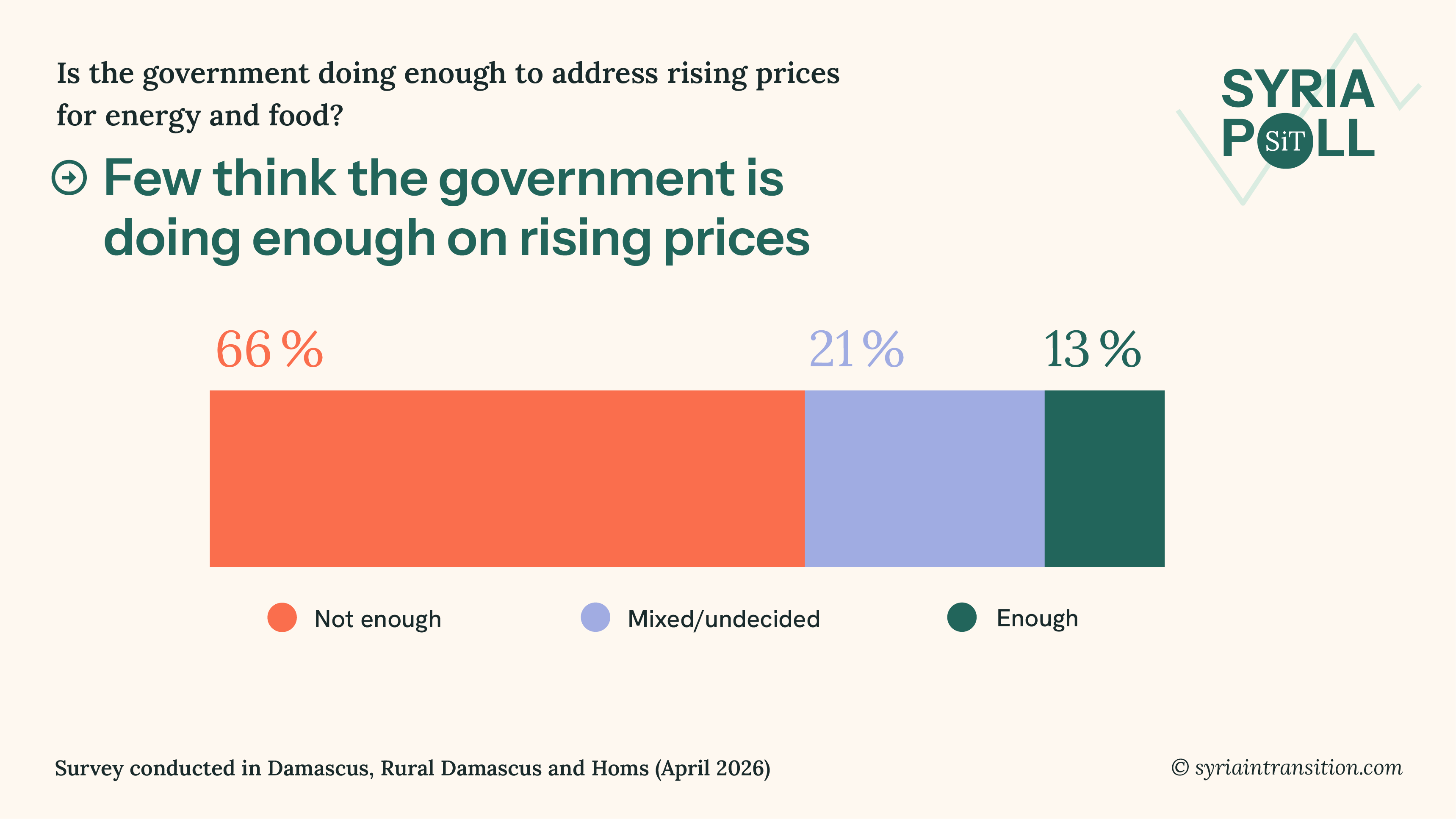
Yet by April the mood had changed. The most serious deterioration was in attitudes toward the economy and the state’s capacity to manage it. Only 13 per cent of respondents now believed the government was doing enough to tackle soaring energy and food prices, while 66 per cent said its efforts were insufficient.
Financial anxiety appears to be rampant. 62 per cent of respondents said they had faced difficulty covering living expenses either daily, weekly or monthly over the past year. Just 10 per cent said they had not experienced such hardship at all.
Satisfaction with public services also collapsed, from 49 per cent in February to just 25 per cent in April; while dissatisfaction nearly doubled, from 16 per cent to 31 per cent. The neutral bloc also grew, suggesting perhaps a creeping uncertainty about whether improvement is coming at all.
Perceptions of personal safety — one of the government’s strongest assets in February — worsened markedly. The share of respondents who said they felt safe fell from 67 per cent to 38 per cent, while those who said they felt unsafe rose from 8 per cent to 26 per cent. The class divide was stark: in higher-income areas 69 per cent still reported feeling safe, compared with only 12 per cent in lower-income neighbourhoods.
Explaining the numbers
A note of caution should, however, be sounded. It may be that public sentiment did not in fact change nearly as much in two months as the figures imply, but that respondents in February were still too cautious to express their true views openly. The threat posed by the Syrian Democratic Forces – viewed by many Sunni Arabs as an existential challenge – had not entirely receded, the integration agreement having only been signed on 29 January. By mid-April, as that deal advanced, some of that hesitation, and the linked tendency to see the authorities as a protective force and give them the benefit of the doubt, may have ebbed. Additionally, growing awareness of economic distress — and of scattered protests and sit-ins circulating on social media — may have convinced people that their frustrations were widely shared, giving them greater confidence to speak their mind.
Also possible is that enumerators in Homs and Damascus had, by the second round, become more skilled at eliciting franker answers from respondents. At any rate, the polls covered only three provinces, with 900 respondents in each wave, and are not nationally representative.
It is probably safe to conclude from the data, however, that many ordinary Syrians are dissatisfied, largely for economic reasons. Steep rise in electricity tariffs were effected in January but only started to bite at scale after the February poll had been completed. The Syrian pound has meanwhile suffered a renewed slide, weakening from roughly SYP10,000 (old denominations) to the dollar in February to around SYP13,000.
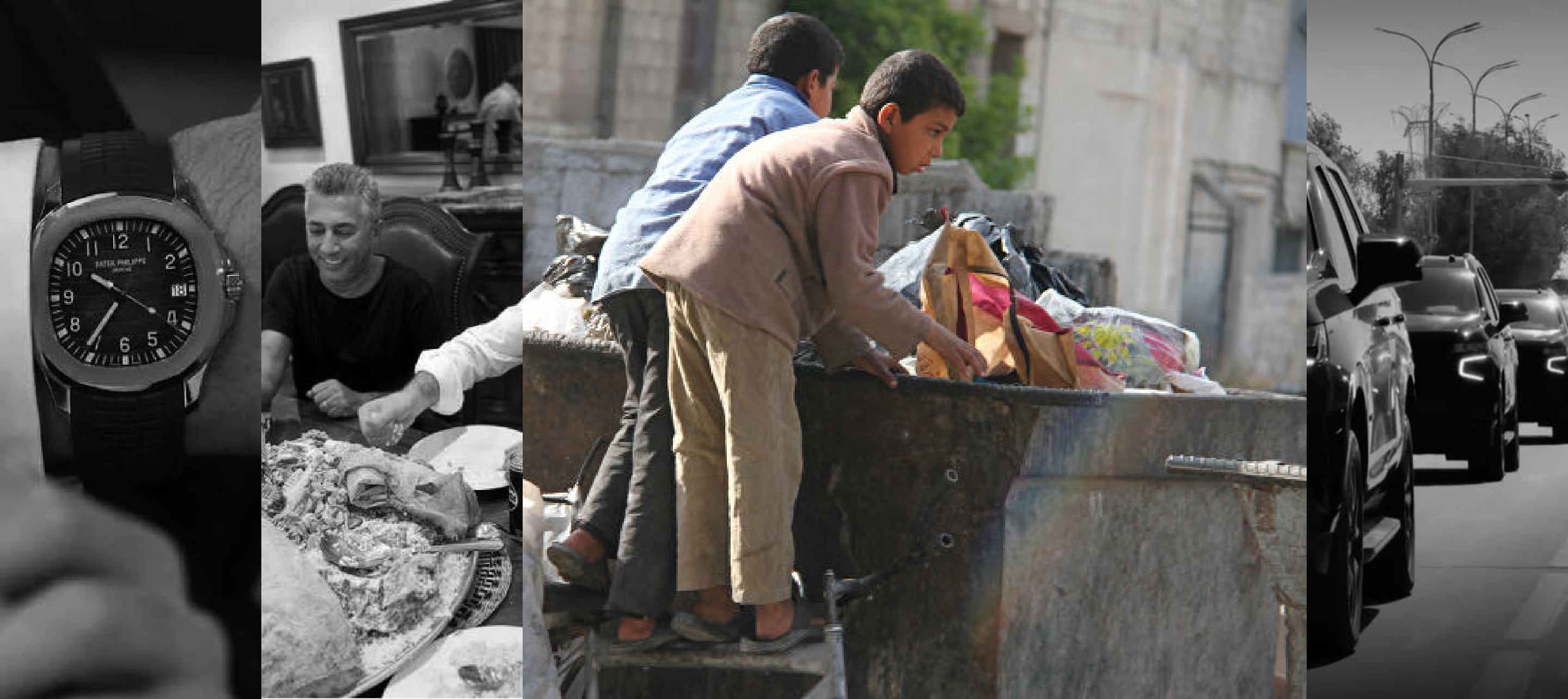
The resultant erosion in purchasing power has been severe; families that could once buy fruit and vegetables by the box-load have been reduced to purchasing them piece by piece. The financial strain is compounded by a loss of social status, a grievance likely to sting as much as the hardship itself. Such pressures are liable to worsen perceptions of the government across a range of measures, whatever the underlying performance data may show.
Privatisation drive
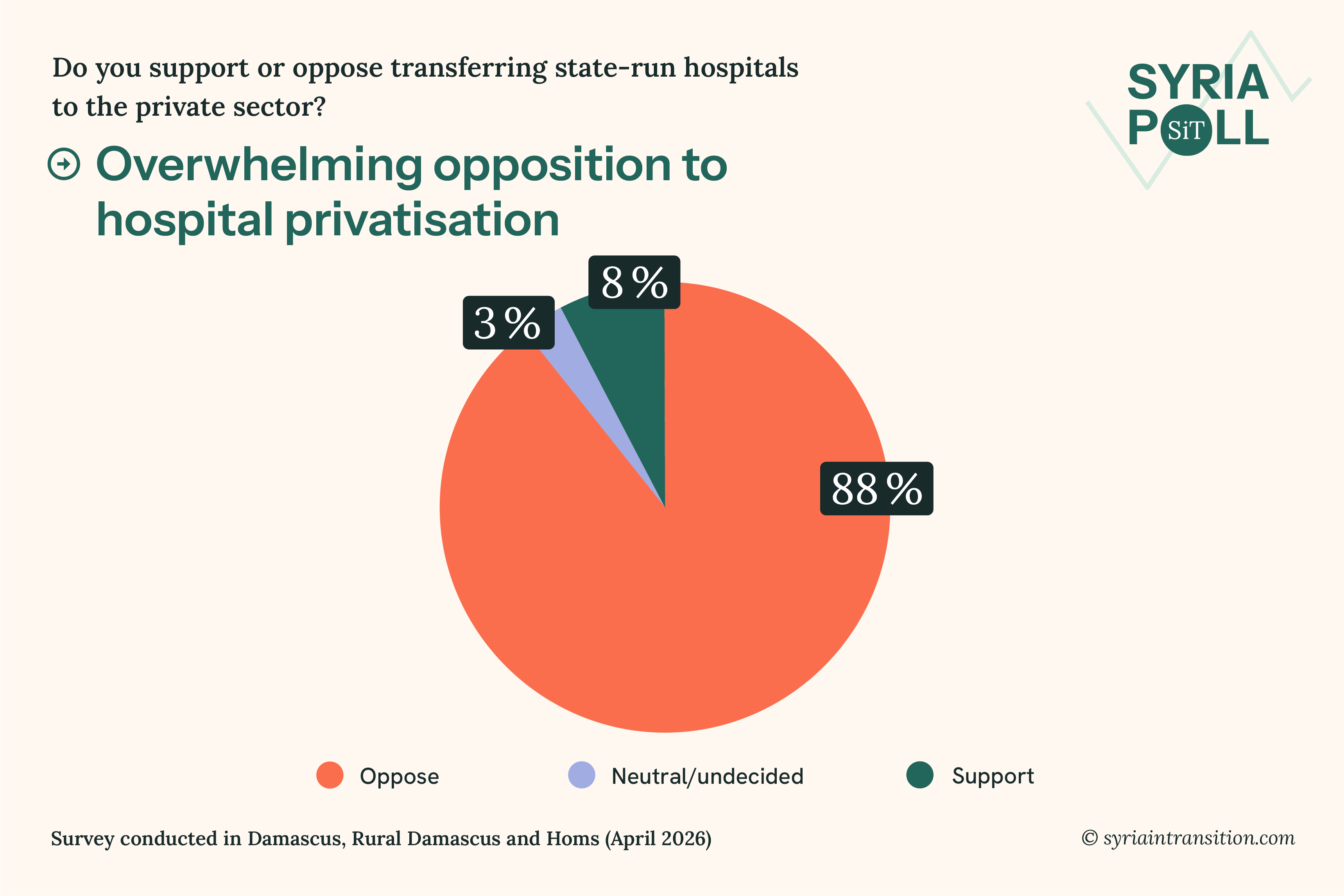
Public dissatisfaction and government policy may soon collide head on over the future of state-funded healthcare in Syria. Concern over the future of 71 hospitals intensified after Talal al-Hilali, head of the Syrian Investment Authority (SIA), said on 8 April that they would be transferred to “operators from the private sector” to run for profit, albeit “in partnership with the state”. For many Syrians, the remarks raised the prospect that one of the few remaining universal public services could be opened to market forces. According to our polling, 88 per cent of Syrians oppose the privatisation of the health sector.
The issue appears to be controversial within the government itself. Health minister Mus’ab al-Ali struck a more cautious tone in an interview on state television on 14 April, insisting that public provision would remain central to the system. Sources in Damascus suggest that the conflict between his defence of state ownership and the SIA’s privatisation agenda might result in his replacement in an upcoming cabinet reshuffle by someone decidedly more neo-liberal.
More generally, with violence nationwide at a record low, popular attention is re-focusing on bread-and-butter issues. The government’s problem is that people are no longer assessing the quality of present-day services against the power shortages and insecurity of a year ago, but against what they believe services should look like in “normal” times: namely, the standards of pre-2011 Syria under Assad.
What’s the deal?
The legitimacy of the current government rests on two pillars: its having led the armed revolution to victory (which appeals to the 25-30 per cent of Syrians who participated in it in one way or another), and its promise of a more prosperous future (everyone else.) The formula currently being pursued to achieve prosperity, however, borrows heavily from the venture capital and private equity manuals, which have brought very mixed results elsewhere. This approach may still work, but it will need transparent national debate and consensus.
The HTS-led government in Damascus doesn’t enjoy the luxury that Assad had of being able to disregard the views of the people. The ‘dignity revolution’ was meant to bring with it respect for the ordinary citizen. Even Assad’s rule rested on more than fear. There was an implicit social contract: political obedience in exchange for subsidised essentials and a social safety net.
With subsidies all but gone and privatisation high on the agenda, many now wonder what kind of social contract is in the offing.