The old bargain between religion and state lives on
Grand Mufti Hassoun’s life sentence has opened the book on religious co-option. Will anyone turn the page?
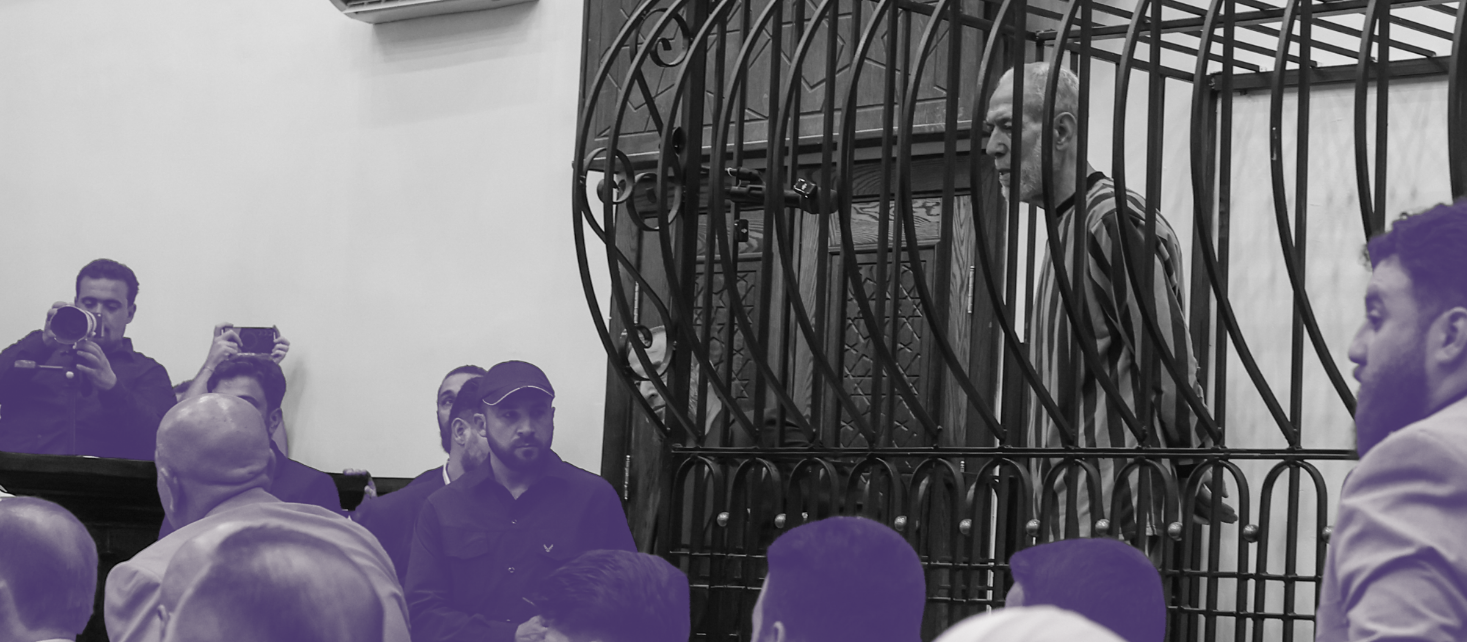
In sentencing Ahmad Hassoun to life imprisonment, the judges cited his abuse of office for personal enrichment and incitement to violence. But Hassoun was not a black sheep. He was part of a system in which parts of the Sunni religious establishment were entangled with the Assad regime. Most of these networks have since found accommodation with Syria’s new rulers.
The trial and conviction of Ahmad Hassoun, the former Grand Mufti, are the biggest steps yet taken towards reckoning with the role parts of Syria’s Sunni religious establishment played under Assad. After the Muslim Brotherhood’s insurgency in the 1980s the regime cultivated a tightly sanctioned field of ‘official Islam’, using selected religious actors to reach constituencies it could repress but never fully penetrate through its Baathist language. On 24 August the Fourth Criminal Court in Damascus sentenced Hassoun to life imprisonment on charges of abusing his office and inciting violence. Detailed records of the evidence presented and the defence’s case have not been made public; but one of the gravest allegations against Hassoun appears not to have been addressed at all: Amnesty International had previously reported that he participated in Sednaya’s bureaucracy of murder by approving death sentences. In a statement to the fact-checking platform Verify-Sy in June, the Justice Ministry denied the veracity of claims by activists that formal investigations had uncovered this to be true. Big question marks therefore remain, feeding concerns that a broader examination of the Mufti’s office and religious brokerage is not on the judiciary’s and government’s agenda.
“The most painful paradox is the disparity in treatment,” a Syrian academic and former representative of an armed Islamist group told Syria in Transition. “Hassoun is sentenced to life imprisonment and has his assets confiscated, while hundreds of those who signed the same statements, delivered the same sermons, blessed the ‘reconciliation’ deals that emptied cities and bore false witness against their own people continue to speak from the same pulpits.”
Converting religious influence to money and power
According to insiders, established systems of co-option and authoritarian bargaining, in which religious influence can be converted into money and other forms of power, continue. One major gateway is religious endowments such as properties and revenues, administrative positions and appointments, as well as restoration and reconstruction contracts. In a country where roughly half of all mosques have been destroyed, there are many opportunities for enrichment. A second, similarly opaque gateway is charitable and relief work through sheikhs who exercise control over budgets, recruitment and access to foreign donors. A third is religious education, ranging from local institutes to study missions and foreign accreditation. The fourth, and particularly sensitive, is mediation: sheikhs acting as intermediaries in local conflicts, property disputes and other settlements, directly leveraging their connections to the security apparatus.
The continuity of this authoritarian bargain is particularly hard to track because today’s religious landscape is more dispersed and, to a much greater extent, funded from abroad, than the comparatively centralised and hierarchical model established by Hassoun’s predecessor, Ahmad Kuftaro. The UAE, for example, has entered the religious sphere through cooperation with the new Grand Mufti, Usama al-Rifai’, under the banner of “moderate fatwas” and by funding the restoration of the Umayyad Mosque and historic religious schools. In a highly unusual first, Syria’s Minister of Religious Endowments, Mohammad Abu al-Khair Shukri (whose sermons a young Ahmad al-Sharaa attended), visited the UAE and was received by its president. Turkish networks and Syrian diaspora communities in Europe and the United States play significant roles as well.
Symbolic purge
Administrative removals have so far affected only a limited number of individuals, among them Mahmoud Akkam, the former mufti of Aleppo, and Abdullah Mohammad Adib Hassoun, the former Grand Mufti’s brother. The boards of trustees and directors of the Sheikh Ahmad Kuftaro Complex were also revised, while members of the Farfour family were removed from the Al-Fath Islamic Complex. Yet the vast majority of sheikhs from the old religious apparatus continue their activities, and some, such as Sheikh Naim Araksousi and Abdul Fattah al-Bizm, have moved into influential positions within the institutions of the new state.
“We are seeing a symbolic purge that targets a few scapegoats,” a well-placed source within the religious establishment told Syria in Transition. “It has little to do with justice and will produce an even deeper sense of impunity than before.”
Public discussions and media coverage have so far focused on some of the deals the government made with members of the business elite who prospered under the Assads – and who were often themselves interwoven with the religious establishment. This is not only because business is a less sensitive subject than religion, but also because deals with sheikhs concern a very different kind of capital from the financial and material wealth of businessmen. Money always plays a role, but a sheikh’s capital is fundamentally symbolic: his pulpit, his circle of students, his charitable associations and his public standing. Settlements involving this kind of capital leave few paper trails. Loyalty in return for impunity can be explicit, through sermons about stability or fatwas on obedience to the ruler, but it can also take the form of silence about misconduct by the authorities.
Divisions in the religious establishment
“After Assad fled, Hayat Tahrir al-Sham was more concerned with reaching accommodations with religious authorities that had opposed Assad than with addressing those associated with his regime, as it sought to consolidate its own authority over the religious sphere,” an interlocutor from Sunni clerical circles told Syria in Transition. Notably, the dividing lines are not primarily doctrinal. Broadly speaking, Sufis and Salafis have a long history of theological disagreement, but those differences are relatively stable. The present struggle concerns control over pulpits, endowments, curricula, the issuance of fatwas, religious education, grants and access to foreign funding – the resources and institutions that, taken together, confer the power to represent Syria’s Sunnis. But doctrinal language is often used to frame these struggles and mobilise constituencies around them.
“Ultimately it’s a divide over legitimacy,” the Syrian academic and former representative of an Islamist group said. “The real dividing line within the religious establishment is between those who remained in regime-held areas and performed their religious role under Assad’s authority, and those who went to opposition-held areas or into exile. A Sufi from the anti-Assad Syrian Islamic Council may therefore find himself closer to a Salafi from the north than to a Damascene Sufi who served under Assad.”
The lack of institutional reckoning is already visible in the public behaviour of former Assad-era clerics. Responding to the limited debate over the involvement of Sufi sheikhs in the Assad regime’s rule, former loyalist Sheikh Abdul Aziz al-Khatib in 2025 urged the Ministry of Religious Endowments to act against what he described as the defamation of Sufism. Among broad segments of society, criticism of a sheikh tends to be understood as criticism of religion itself – something religious authorities are well aware of.
From the perspective of the government in Damascus, as with transitional justice more broadly, it remains unclear whether deeper reckoning is desired. Some of the hesitation may simply reflect a country still preoccupied with the rough stitching needed to hold itself together. But there are political incentives for leaving the finer work undone as well. The Assad regime built structures that turned parts of the religious establishment into instruments of rule. Why dismantle structures that can be put to work for a new order? Moreover, many of those who would be expected to lead truth-seeking and reform are themselves part of the religious or political establishment in question.
Prelude to reform – or case closed?
Something has nevertheless changed. The debate over the political responsibilities of the religious establishment, previously largely confined to social media, now has a legal dimension: Ahmad Hassoun’s trial moved the issue from the realm of moral blame towards legal responsibility, with the office of the Grand Mufti itself named as having served the Assad regime. Whether this marks the beginning of institutional truth-seeking, or whether a few prominent figures will be made to stand for a system left largely unexamined, remains to be seen.
A glance at international examples offers some perspective. The reckoning of Germany’s Christian churches with their role under National Socialism shows that systematic institutional self-examination can take decades to emerge. Perhaps Syria need not follow the same path of avoidance. It certainly can draw on reform-oriented voices within its religious sphere to encourage an open debate that wasn’t possible in Germany’s hierarchically organised churches at the time.
Over time, the idea of a Truth Commission on Religious Affairs could gain momentum. Its purpose would be to create a record and archive, gathering testimony and documenting the mechanisms of cooperation, co-option and subordination as a safeguard against their recurrence. Institutional reform could then take several forms. The Office of the Grand Mufti could be separated from the executive authority by requiring the Grand Mufti to be elected by a group of peers (rather like the Pope), as opposed to the current practice of appointment by presidential decree. The creation of the 14-member Higher Fatwa Council, announced by the President in March 2025, which includes a balance of Salafists and Sufis, was meant to democratise the issuance of fatwas. It could serve as Syria’s Sunni answer to the Cardinal Electors. Alternatively, the position could be abolished as a sovereign state office altogether: a state governed by a civil code may have little need for official fatwas.
The Ministry of Religious Endowments could move away from doctrinal guidance and concentrate on the administration of properties and services. Many experts that Syria in Transition spoke to supported the idea of turning the ministry into an independent commission headed by a non-clerical technocrat. The rationale was simple: since the Ministry of Religious Endowment’s main task was to generate revenue to maintain schools and mosques, this should not be in the hands of a cleric who may preference his own networks and belief-group over others. Unified sermons and loyalty pledges that have done much to discredit the Sunni clerics could likewise be abolished, allowing greater religious pluralism while retaining reasonable boundaries against incitement. Drawing those boundaries would require considerable fingerspitzengefühl. It is, after all, part of the much broader question Syria now faces over where freedom of expression ends and incitement begins.
The Syrian academic and former representative of an Islamist group argues that the religious establishment needs to be disentangled from the state to protect the faith. “For me, the measure of the new Syria is not its ability to produce obedient sheikhs. That is the easiest thing to do, and the current government’s predecessors mastered it. The measure is whether it can tolerate a sheikh who tells it: ‘No’.”