Who can afford a burger in the new Syria?
A restaurant review of Cali in Damascus
Our restaurant critic Nadim al-Sufra has an eye for people, an appetite for good food, and opinions about both.
I had spent a long day wandering the labyrinthine old city of Damascus, accompanying a visiting friend along the well-trodden path of Syrians returning to see their country for the first time in years following the fall of the Assad regime. One never quite gets enough of the old city, but it can be exhausting to spend a day there in the July heat. So when my friend suggested dinner at Cali, I accepted with little persuasion.
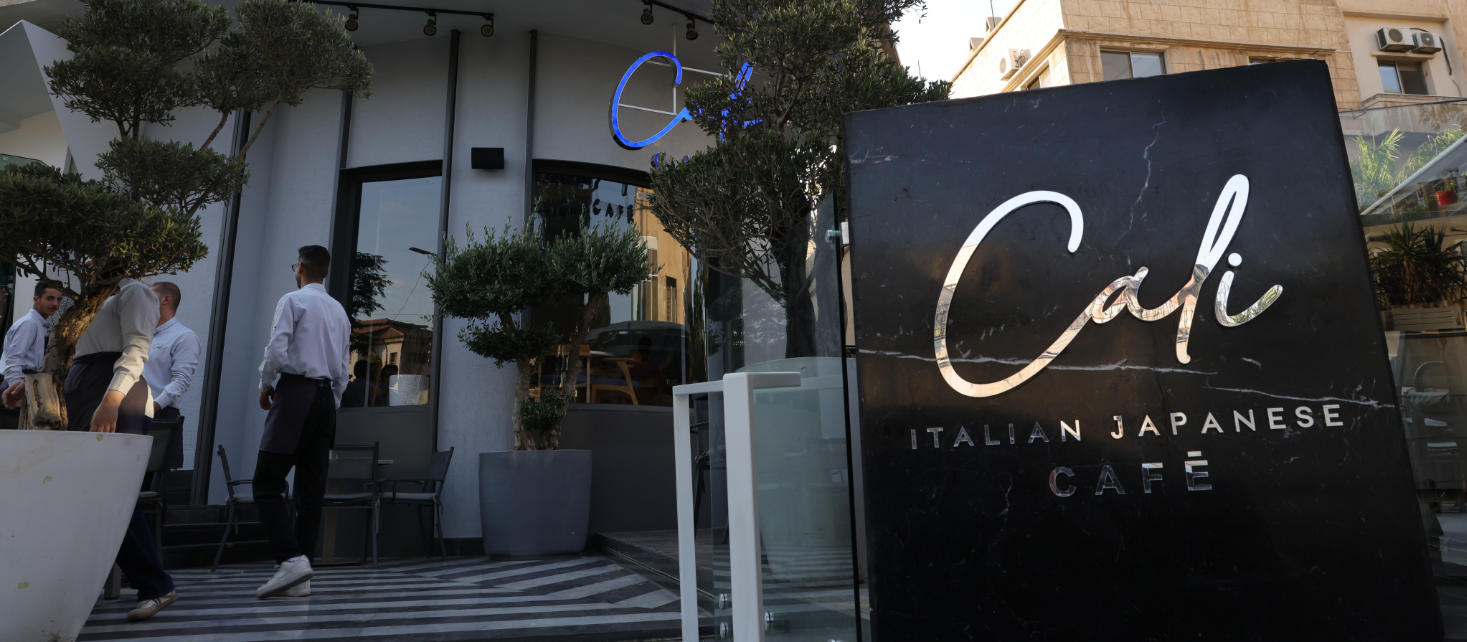
Cali is the kind of place one likes to scoff at: a restaurant named after the American state of California, billing itself as Italian and Japanese while serving a host of internationally recognisable staples besides. At the back of its lovely terrace, a two-tone blue-and-white Volkswagen camper van from the 1970s, converted into a matcha bar, offers no fewer than eight kinds of this beverage that has conquered much of the world and refused to leave even this once isolated, war-torn country untouched. At the same time Cali is a very Syrian restaurant. It is the sort of place where many middle- and upper-class Syrian families like to spend their leisure time, much more than at an old courtyard-house-turned-restaurant in the old city. For us, having paid sufficient tribute to heritage earlier in the day, a place like Cali was just what the doctor ordered.
The ‘Yalla Go’ driver dropped us off in front of the restaurant and, no sooner had we climbed the three steps to the terrace, our backs to the Saudi embassy compound across the street, than a few dozen heads rose in unison. Their owners subjected us to the swift but searching appraisal at which Damascenes excel: one part Sherlock Holmes exercising his art of deduction, one part St Matthew establishing an immaculate register of who begat whom. Satisfied with their preliminary findings, most quickly turned back to their fellow diners, some muttering words that perhaps echoed those of their forebears: they no longer recognised anybody in this city.
A courteous waiter sporting a moustache led us to the only table for two that was available outside without a reservation – the indoor area remains largely deserted during the summer months. After stopping to say hello to two acquaintances, we settled into our seats, my back to the Volkswagen matcha bar. Next to us, a group of over a dozen Syrian teenagers from well-to-do families were enjoying dinner while conversing in Arabic and English, and on the other side of their table sat a Turkish businessman with his dinner companion.
Often in Cali someone stands out: a person interesting enough to attract attention, yet not enough of a regular to blend into the furniture.
The rest of the clientele consisted of deep-pocketed Damascenes. Some had never left the country during the war; others had stayed, and were frequent international travellers. There were businessmen confidently talking politics and the economy, and families trading lighthearted gossip. Scattered among them were the occasional non-Syrian who works for the UN or a foreign embassy. Often in Cali someone stands out: a person interesting enough to attract attention, yet not enough of a regular to blend into the furniture. On this occasion, it was one of the newly appointed Members of Parliament – one of New Syria’s latest innovations, whose positions inspire remarkably little envy at home or abroad. Few, if any, of the other diners appeared to recognise the MP. Their facial-recognition software, so to speak, had yet to receive the latest update.
I have been to Cali a few times since returning to Syria. The restaurant opened in 2019, a little more than five years before the fall of Assad. While I do not know who was frequenting it back then, I suspect that it was not much different from now: those who stayed yet managed to weather the overwhelming pauperisation of the Syrian people, and those who had built lives abroad while still returning regularly long before the fall of the regime.
It was time to order. I like Cali’s food, although I do not find it uniquely exquisite. “If all the year were playing holidays,” Shakespeare has Prince Hal say in Henry IV Part I, “To sport would be as tedious as to work,” and the same goes for the food in Syria. Even the delicious feasts of cold and hot mezzes performing the opening act for grilled and spicy meats can become repetitive and dull after a while. Cali continues to serve alcohol, despite being in a majority Muslim neighbourhood and the country being in a precarious transitional period, when one cannot take such personal freedoms fully for granted. There are no cocktails, but they have local and Lebanese wine and beer. As for food, we ordered a couple of appetisers to share, followed by a Schnitzel and a burger for mains. My friend smoked a shisha.
I apply a different standard to international dishes like burgers depending on where I am eating them. In Damascus, the burger was sufficiently elegant and enjoyable – though it may not have been something to write home about had I been trying it in New York City or Chicago. The thick beef patty with melted cheddar and crisp beef bacon came enclosed in a glossy brioche bun with a side of fries and cornichons. It hit the right notes. I liked the overall taste and so far I have not tasted a much better burger in Damascus. The schnitzel consisted of two generously sized chicken fillets coated in crisp golden breadcrumbs and served with thick-cut fries, a handful of rocket, cherry tomatoes and a wedge of lemon. I liked that they call it 'Schnitzel' on the menu, and not the catch-all French term 'escalope,' as this sort of dish is so often labelled in Syria and Lebanon.
Cali is out of reach for the majority of Syrians – and it does not pretend otherwise.
As we were eating, the Turkish businessman approached the teenagers’ tables and histrionically introduced himself, asking them where he could find the best nightlife scene in Damascus. The friendliest suggested Z Bar, on the rooftop of the Omayad Hotel. After a somewhat labored attempt to keep the conversation going, the man returned to his table.
After finishing our plates, we skipped dessert or coffee, and it was time to pay. The damage came to about $30 per person, by no means an insignificant sum, and we could have had a luxurious Syrian meal at several other places for less than that. As in most Syrian restaurants, the bill includes taxes and items customers may not have explicitly ordered, such as bottles of water. We also factored in about 10% for tip, which I usually hand directly to restaurant staff, after several workers told me that tips left with the bill are not always divided fairly among them.
Cali is out of reach for the majority of Syrians – and it does not pretend otherwise. The restaurant is unapologetically geared towards local families and others who do not look out of place among them. Its Instagram page communicates exclusively in English. While not left with members-only clubs like their counterparts in Aleppo, the elite of Damascus are still trying to maintain strongholds where familiarity can be reserved during yet another period of transition, even if that familiarity now rests on purchasing power.
If one is not willing to spend a considerable sum of money on such an escapist culinary venture, I suggest going to Cali in the morning (they open around 9:30) or a leisurely afternoon for a coffee or a fresh juice. Although you may be able to eat better elsewhere for less money, Cali remains a pleasant place, and few cafés in Damascus offer a better vantage point from which to observe what is – and, even more, what is not – changing in the new Syria.
Cali Café, Nizar Qabbani Street, Abu Rummaneh, opposite the Saudi Embassy, Damascus. Reservations: +963 11 335 4086 or +963 957 777 138. Instagram: @calicafe.sy