Lessons in obedience
How Syria’s schools reproduced authoritarian rule beyond the classroom
School is where children first encounter state authority in a sustained way: through everyday discipline, hierarchy and the regulation of speech and behaviour. In Assad’s Syria, this meant taking first steps in a system where violence, corruption and opportunistic spying on others were treated as practical virtues. What’s left of it?
If authoritarian rule – and, by extension, the prospects of liberalisation – depend on how people learn to see and interpret the world, then schooling is central to Syria’s ongoing political transition. Under the Assads, schools were designed to produce loyal citizens through militarised indoctrination. They also trained young Syrians in navigating life in a state of corruption (manẓūmat al-fasād) — thereby reproducing it.
Educational reform cannot be reduced to revising curricula or updating teaching methods. The school itself has to be taken seriously as a social institution and interactional space: a place where everyday authority relations are learned, where trust can be undermined or rebuilt and where the basic grammar of social cooperation is rehearsed long before students encounter formal politics.
The school as an extension of the security state
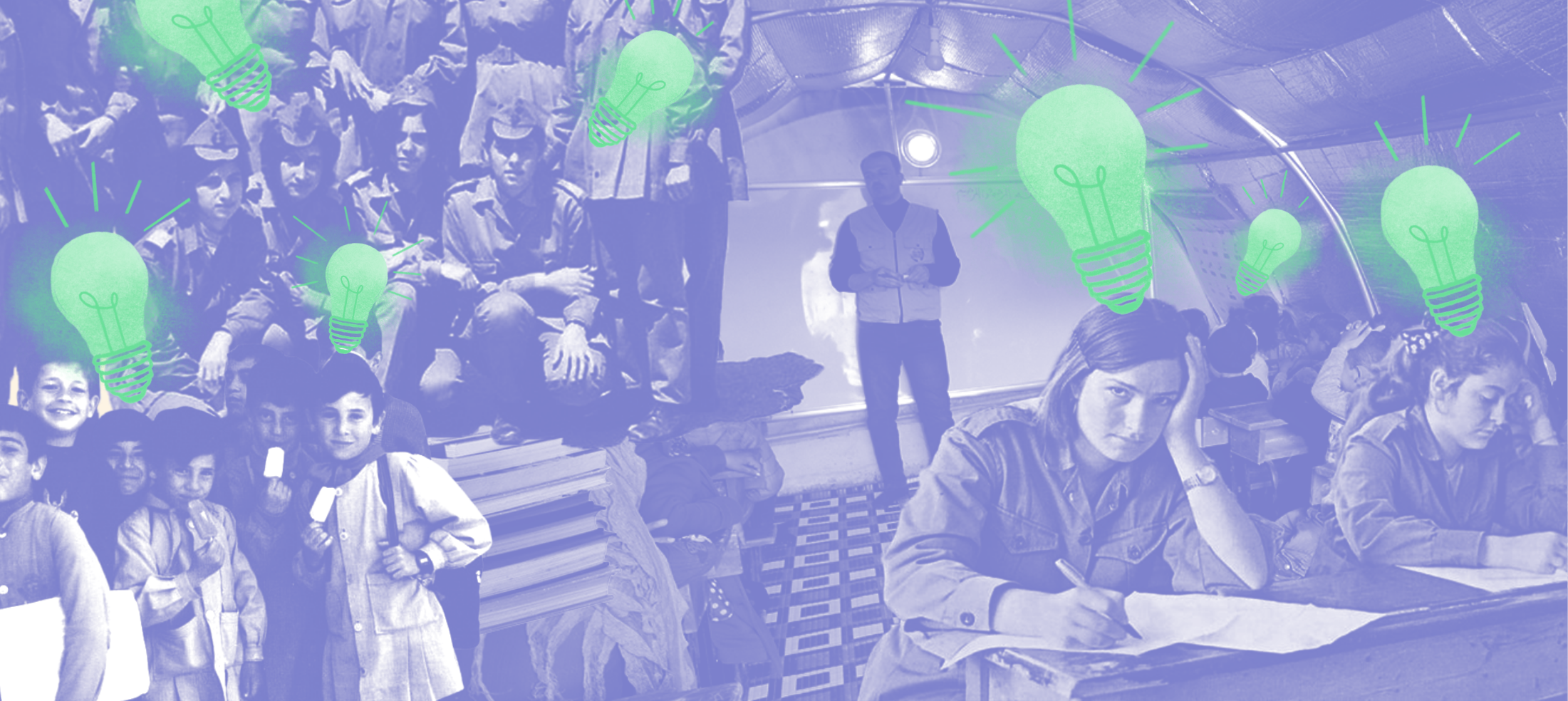
Schools in Assad’s Syria were tightly woven into the organisational architecture of the Ba’ath Party. Beyond obligatory flag rituals and leader worship, students were gradually integrated into the party structure. Beginning in preparatory school, they were expected to join Ba’ath youth organisations; and by secondary school many were encouraged to become full party members. In return, students could receive up to twenty additional points on their final baccalaureate score – a substantial advantage that could determine university admission and future career prospects – usually in exchange for attending party training camps or carrying out party-related tasks.
After completing the tenth grade, students had to attend a “summer camp.” The name suggests tent and campfire atmosphere but these four-week camps usually took place in local school buildings as full-day programmes, with students returning home only to sleep. They combined ideological instruction with basic military-style training. In addition, students were required to attend regular party guidance sessions held after school roughly every two weeks.
Key institutional figures in this system were the military instructor (futuwaa), and the more administrative supervisor (muwajih). When active military training in schools receded in the early years of Bashar’s rule – when he was seeking to project the image of a reform-minded civilian leader to avoid becoming the next US target after Saddam Hussein – many military instructors became supervisors and maintained personal firearms, as one interviewee recounted. Acting as intermediaries between schools and the Ba’ath party and intelligence services, they monitored teachers, disciplined students and served as institutionalised channels for denunciation. Students learned early that words could travel, that classmates might double as informants and that caution was a basic survival skill. This made schools function as orientation spaces for social life. They provided the moral scripts and behavioral cues through which authoritarian order reproduced itself from below. The core premises were that obedience was a civic virtue, and that disobedience invited physical punishment.
‘The flesh is yours, the bones are ours’
Over time, the culture of disciplinary violence became embedded in society. Interviews conducted by Syria in Transition repeatedly point to a societal demand side: some parents actively expected teachers to “raise” children through corporal punishment, and interpreted a lack of physical sanction as a sign of institutional weakness. This expectation could be interpreted simplistically, as a feature of patriarchy; yet the reality appears more paradoxical. Several active and former teachers stressed that families calling for a “hard hand” at school were not necessarily those who used violence at home. For them, violence was delegated to the school and legitimised as preparation for life in an authoritarian social order where bodies had to comply and minds had to endure. One teacher commented that after the “stick” disappeared following Assad’s fall, many teachers “lost their authority,” because fear of physical pain carried more weight than moral reprimand or psychological pressure alone. After decades of systematic brutalisation in schools, authority appears to have been reduced to the capacity to inflict physical harm. The classroom thus taught a social lesson: status and control are anchored in coercive capability; and legitimacy attaches to those who can credibly enforce boundaries.
Bashar Assad’s reported claim that the only way to govern Syrian society is “with the shoe over people’s heads” found its classroom counterpart. One teacher told Syria in Transition - with a degree of pride - that merely mentioning her shoe size in front of the class was enough for students to obey. Another teacher recounted how, after a student insisted that “the stick is forbidden,” the teacher replied that the prohibition applied to the stick, not to punishment – and enforced compliance by striking him with his hand instead. The episode was remembered as a turning point: the teacher’s authority in the classroom solidified once coercion had been publicly demonstrated.
Attitudes toward corporal punishment, however, are far from uniform. In a poll conducted by Syria in Transition in April 2026 among 900 respondents in Damascus, Rural Damascus, and Homs, 62 per cent said physical punishment in schools was “never acceptable.” Another 19 per cent said it was “rarely acceptable,” while 11 per cent considered it “sometimes acceptable” and seven per cent “completely acceptable.” While corporal punishment remains socially embedded, it is also widely contested.
A culture of cheating
Beyond the regime’s overt coercion, classrooms also reflected a deeper logic of social and economic mobility under Assad’s highly corrupt, pyramid-like kleptocracy. School was a testing ground where students took their first steps in a system where the abuse of power, opportunistic manoeuvring and strategic rule-breaking were treated as practical virtues - and, for many, as prerequisites for advancement. Exams were therefore arenas in which the skills of transgression were rehearsed within a broader culture of cheating.
Those with money, status, or access to kinship-based networks were given privileged treatment, often in absurd ways where teachers had to tolerate massively disrespectful behaviour because of how powerful a student’s family was. The classroom mirrored the patterns of wider Syrian society, where power outweighed formal rules and corruption was part of the operational grammar of everyday life. Syria’s educational landscape has long been heterogeneous, spanning public, private and religious institutions; and interviews with teachers and education professionals underline that these practices varied across school types and local contexts. Interviewees consistently opined, however, that corruption was most routine in public schools. Where direct cheating proved difficult, students relied on gifts or informal payments to secure grades. In some accounts, the transactional logic of schooling became almost performative. As Loubna Mrie describes in her memoire Defiance, her teacher would write her shoe size on the blackboard ahead of “Teachers’ Day,” signalling preferred gifts to parents. This was a not-so-subtle code that could translate into hints about exam content or the informal purchasing of marks.
Pervasive petty corruption among teachers was not simply an individual ethical failure. It emerged from a shortage economy in which the teaching profession was intentionally underfunded and structurally de-professionalised. Low salaries and weak investment in teacher training meant that corruption was a means of survival. At the same time, the regime’s political expectations narrowed the role of teachers. They were not expected to open cognitive horizons and enable independent judgement. Their primary role was to transmit Assadist dogma and maintain order.
A difficult inheritance for the post-Assad era
With Assad gone, everyday school life has changed. The Ba’ath party, with its obligatory propaganda rituals, is no more, and the mukhabarat no longer monitors classrooms and corridors. That has brought a sense of calm and psychological relief to schools. Yet this mood is better understood as part of a broader post-regime “honeymoon” than as evidence of deep institutional reform. In organisational terms, continuity remains striking. Much of the teaching staff trained under the old system have stayed in place. Teachers also point to weak coordination (such as training courses on how to teach the updated curriculum) and opaque guidance from the Ministry of Education, complicating attempts to establish coherent standards across a fragmented educational landscape.
In some areas, the state appears to be trying to compensate for limited institutional capacity by renewed displays of presence and control. Some teachers assert that stricter oversight has reduced cheating and petty bribery. Others strongly dispute this. It is hardly surprising that removing Assad portraits and changing flags does not automatically dissolve behaviours learned over decades, especially when economic pressures and institutional habits that encouraged them remain in place.
The most acute challenge, however, concerns the status and capacity of the teaching profession itself. Many teachers entered classrooms without proper qualification amid wartime staff depletion. Low investment in teacher education and poor economic conditions continue to plague the sector. The result is a profession struggling with basic survival. For many teachers, the central question is whether a salary can sustain their household beyond the middle of the month. Teachers’ strikes and protests across different regions since late 2025 and into early 2026 underscore the depth of this crisis but haven’t achieved substantial change.
Teachers as trustees of civic maturity
For most children, school is the first sustained encounter with state authority: the place where the state becomes tangible through everyday discipline, hierarchy and the regulation of speech and behaviour. At a moment when Syria is trying to recover from civil war while building a new state and social contract, schooling carries enormous potential for genuine change. It should be treated as a national institution of reconstruction rather than simply another public service to patch up.
The material dimension of this challenge is immense. More demanding teaching methods and the increasingly complex content of new schoolbooks require educators who are professionally equipped and economically secure. Adequate pay, proper training and social recognition are prerequisites for turning teachers into credible trustees of civic maturity who can guide, protect and challenge students.
No less complex is the question of how schools themselves are organised: the routines, incentives and informal practices through which authority is exercised and reproduced in daily life. Neither the Ministry of Education nor the wider state can expect to move on from authoritarianism while preserving the social habits and institutional logic that have structured schools for decades. If Syria is to move beyond authoritarianism, the school is a key place to start.
Part III of this research will be published in the July issue and will examine, in more practical terms, how a new educational culture can take root in Syria — and who is capable of nurturing it.