Arabs of the North, unite!
As war exposes the Gulf’s vulnerabilities, Iraq and Syria have an opening. Seizing it will require binding economic ties and a political accommodation across the sectarian divide
In Seven Pillars of Wisdom, T.E. Lawrence described the Arabian Peninsula’s conveyor belt. Population pressure pushed weaker clans from the highlands of Yemen into the deserts of Najd and the Hijaz and drove them northwards, towards the river valleys and fertile plains of Iraq and Syria. There, herders became farmers and joined the settled populations whose lives the new arrivals would disturb.
This centuries-old south to north traffic ended with oil. From the 1950s, the Arabs of the north began travelling south in search of work, as their teachers, engineers, doctors and businessmen helped build Saudi Arabia and the Gulf states whose wealth would soon dwarf that of their homelands. Iraq and Syria, meanwhile, were progressively wrecked by coups, dictatorship, wars, foreign occupation and terrorism, while the Arabs of the south, with the sole exception of Yemen, accumulated wealth and influence, and increasingly determined what passed for an ‘Arab position’. Saudi Arabia’s Vision 2030 gave this southern ambition its fullest expression, promising international stature and prosperity beyond oil.
Then, the Gulf states were mugged by geography.
Resilience and fragility
The Gulf’s geographic and strategic vulnerability was laid bare by their inability to contain Iran or even its proxies. Their dependence on a fickle US, and the precedence Washington gives to Israeli interests over their own, has come as something of a shock. Perhaps their greatest weakness, however, lies in how little disruption their societies are able to absorb. The comforts and commercial attraction of the Gulf depend on total stability, at home and in the region, and an uninterrupted supply of electricity and desalinated water from plants that are conspicuous targets. So far, the war in the Gulf has cost $15.1bn in lost oil revenue for GCC states and an estimated $58bn in damage to infrastructure. Loss of trade and investment is likely to be even higher. Even before the war, the Gulf’s appetite for skyscrapers and luxury apartments had raised questions about such projects’ economic viability; NEOM is a case in point.
In contrast, the Arabs of the North have acquired, through repeated catastrophe, a capacity to endure disruption and scarcity that their southern neighbours have hardly had occasion to develop. Years of conflict have taught Syrians and Iraqis to keep businesses running through power cuts and closed borders. Such experiences create resilience and resourcefulness, qualities that count for much in an increasingly volatile Middle East. Cooperation would allow them to put those hard-earned qualities to more profitable use.
Lost opportunity
The Gulf’s troubles alone will not draw investors north. Iraq and Syria must work together to offer safe and reliable trade routes and a larger shared market if they are to make the most of the opening.
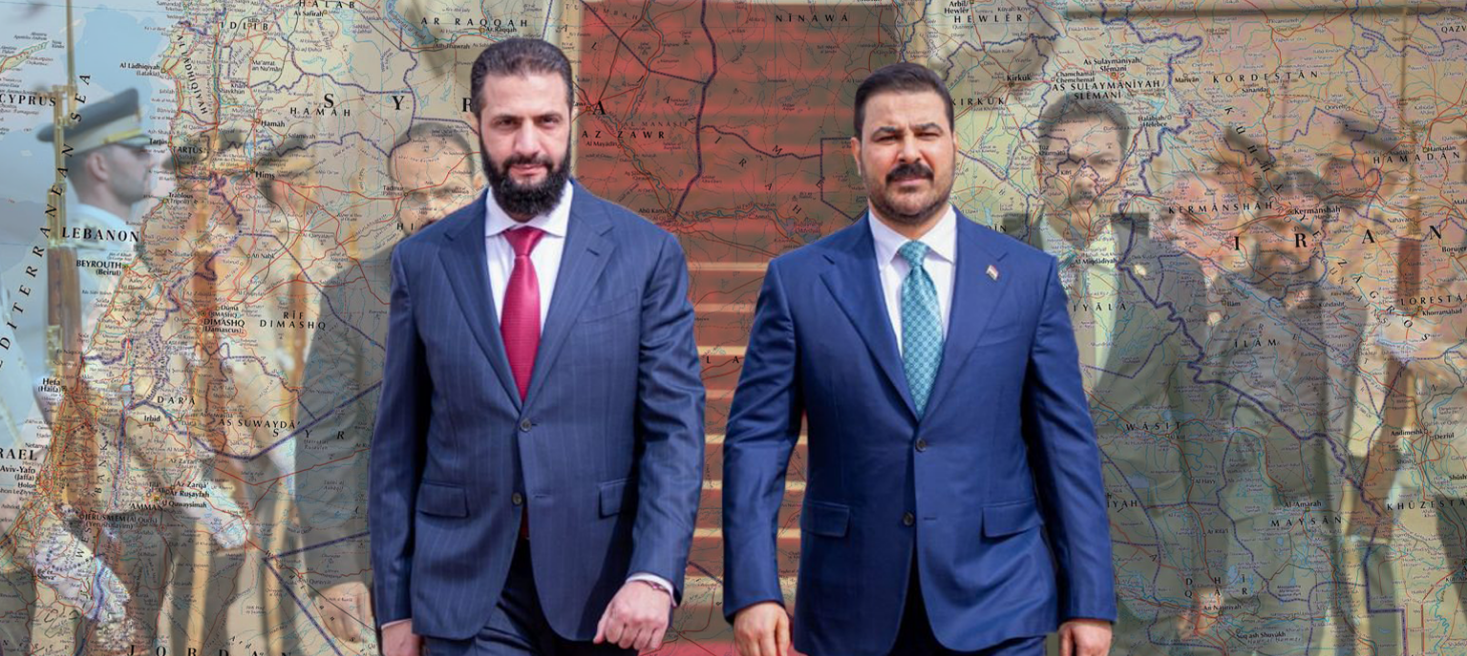
That understanding gave particular significance to Iraqi Prime Minister Ali Faleh al-Zaidi’s visit to Damascus on 28 October, where he met President Ahmad al-Sharaa to discuss energy, investment, and border security. SANA reported that the talks covered “ways to shield Syria and Iraq from the repercussions of potential conflicts through closer coordination”, alongside plans to revive the oil pipeline linking Iraq to Syria’s Mediterranean coast.
The history of the Kirkuk–Banyas pipeline is a barometer for relations between the two countries. Built in the early 1950s as a vital route for Iraqi crude to reach global markets, it was shut by Syria in 1982 after Hafiz al-Assad sided with Iran in its war against Iraq, and spent most of the following two decades out of service. Relations deteriorated so badly that Syrian passports were printed with “Valid for all countries except Iraq and Israel”, with the restriction on travel to Iraq remaining in place until 2001. The pipeline was re-activated as both countries sought common cause against a menacing post-9/11 US. In 2003 it was shut again, this time by US forces in Iraq. Today a new pipeline is being discussed.
It is one of the geopolitical tragedies of the Middle East that Iraq and Syria have so rarely got on. Syrian hostility towards the British-backed Hashemite monarchy in Baghdad helped thwart schemes for union with Iraq in the 1950s, leaving Damascus to pursue its ill-fated union with the more distant (and less compatible) Egypt. The rise of juntas and presidents-for-life in both countries then left relations hostage to rival geopolitical alignments, with Hafiz al-Assad and Saddam Hussein’s mutual loathing adding a personal bitterness to the estrangement.
Freed from the legacy of Saddam and the Assads - and of US occupation - Syrians and Iraqis are now free once again to pursue a common cause. The bargain is that Iraq gets access to the Mediterranean and alternative export routes while Syria gets investment, energy and a substantial consumer market.
What needs to be done
US Presidential Envoy for Syria Tom Barrack has done much to encourage al-Zaidi’s visit to Damascus, with an eye, perhaps, to its commercial as well as diplomatic possibilities. Iraq for its part views cooperation with Syria as a security requirement first and foremost. A 2025 Iraqi National Security Advisory estimate seen by Syria in Transition proposes that Baghdad should “approach Syria from a pragmatic security and strategic perspective, balancing essential cooperation with the need to avoid becoming embroiled in regional conflicts. Cooperation with Damascus should rest on the principle of ‘security first, sovereignty always’.”
For the relationship to have a chance of enduring and blossoming, economic agreements should be accompanied by measures that make initially modest ties more binding and open to expansion.
Economic cooperation should be institutionalised in ways that benefit more than a few well-connected businessmen and politicians, with a customs union as the ambition and arrangements allowing frictionless trade as a starting point. Iraq offers a large consumer market and competes less directly with Syrian producers than Jordan and Lebanon, whose exports overlap considerably with Syria’s.
People-to-people contacts should also be intensified to bring the Syrian-Iraqi relationship to life. University exchanges, civil society partnerships, cultural programmes and sporting events would give young Iraqis and Syrians reasons to learn about each other. Easier travel would benefit everyone from small traders to families and pilgrims. Visa-free travel should be the goal.
Then there is the sectarian question. Sunni-Shia differences should be parked, with clear prohibitions on sectarian incitement and the belittling of other people’s beliefs. Syria’s Charter for Unity in Islamic Discourse offers a precedent for containing the Sufi-Salafist schism within the Sunni fold, establishing rules under which competing traditions can coexist. A similar approach could advance a Sunni-Shia modus vivendi, and without the theological contortions that have accompanied previous (and mainly Gulf Arab-led) attempts to paper over doctrinal differences. An Iraqi-Syrian attempt would be a political measure pursued at a state-to-state level, treating sectarian de-escalation as a matter of good government. That it was Syrians and Iraqis who bore the brunt of sectarian warfare makes reconciliation efforts all the more compelling.
Some of the gestures accompanying al-Zaidi’s visit to Syria suggested an appreciation of this opportunity, beginning with Ahmad al-Sharaa’s decision to meet him at the airport, an honour withheld from some visiting Sunni leaders. Foreign Minister As’ad al-Shaibani’s visit with him to the Sayyida Zainab shrine conveyed respect for Iraq’s Shia community, while al-Zaidi reciprocated with $5m towards the refurbishment of the Umayyad Mosque, despite the Umayyads’ familiar role as the historical bad guys in Shia discourse. The silence from some of the extreme PMF factions, who would have been expected to condemn al-Zaidi, was notable.
Northern powerhouse?
The Arabs of the North should draw closer, starting with the two largest players: Iraq and Syria. Closer cooperation works best when the parties recognise a common threat, as European integration demonstrated with its twin fears of German revanchism and Soviet aggression. Iraq and Syria face religious extremism at home, whether in the form of Islamic State or the more extreme elements of the PMF, and the bullying of Iran, Turkey and Israel from abroad. A stronger relationship between Baghdad and Damascus would make both harder to manipulate or intimidate.