Father of Grime’s new clothes
A restaurant review of Toshka al-Firdous in Homs
Our restaurant critic Nadim al-Sufra visits a Homsi institution once notorious for questionable hygiene but beloved for its food, only to find it transformed into something resembling an international fast-food chain. He wonders whether its transformation is symptomatic of Syria today.
Every true Homsi knows Toshka al-Firdous. This old haunt, which opened in the 1980s, has left such an indelible mark on the city’s gastronomic landscape that it has become as essential to Homs as Abu Abdo al-Fawwal was to Aleppo or Bakdash ice cream is to Damascus.
Al-Firdous specialises in toshka, a grilled meat and melted cheese sandwich, and in fruit cocktails and milk and banana cocktails: items that are popular throughout Syria.
I love toshka and fruit cocktails, and I love an eatery that has a limited number of offerings – a rarity in Syria, where menus are often encyclopaedic, with the greater the variety not necessarily leading to better quality.
Al-Firdous has therefore long been on my list of places to visit in Homs. So when I found myself there for work I made sure to carve out time for this culinary venture.
Walking there from the old city, one could easily tell that its strategic location on Tripoli Road helped cement its place in Homsi gastronomic culture. Nestled between established central and western residential neighbourhoods that house much of the city's urban middle class, such as al-Inshaat, al-Tawzi al-Ijbari, al-Mahatta and al-Ghouta, al-Firdous is also close to various schools, while the famous Safir Hotel is only a few steps away.
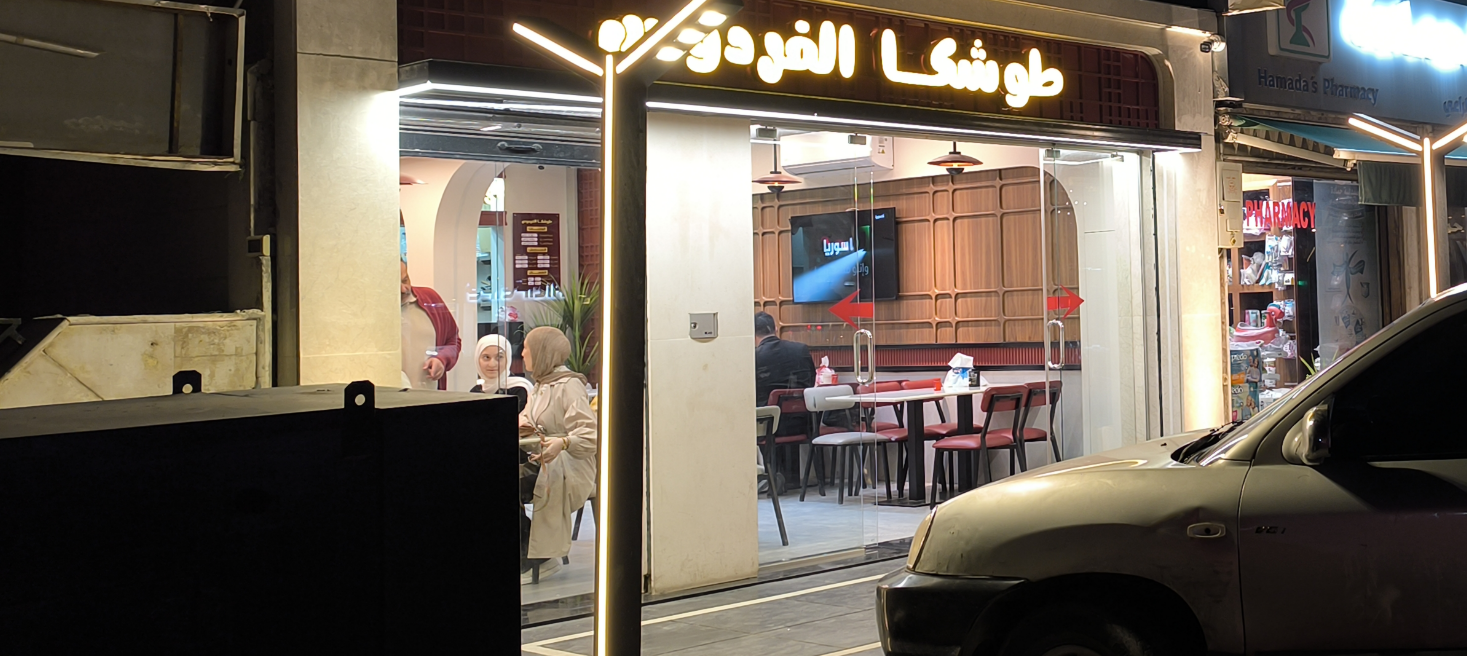
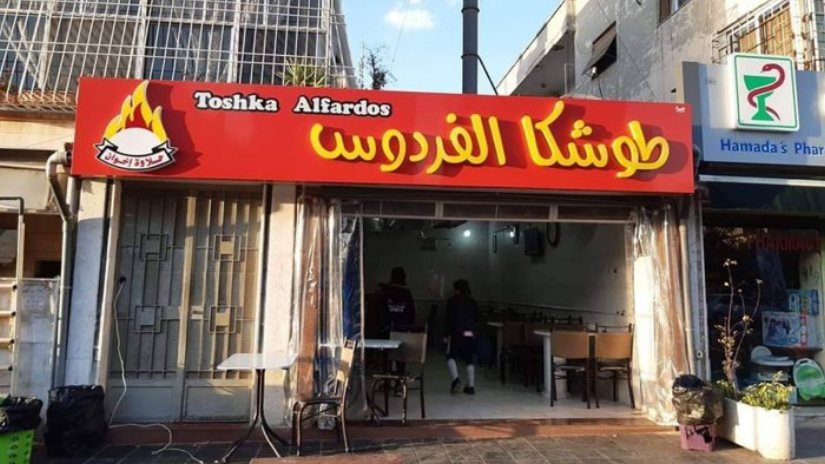
I was aware that al-Firdous had recently undergone a complete refurbishment, but I was not quite prepared for the extent of the transformation. The brightly lit, polished new façade proclaimed the restaurant’s name in glowing, rounded and playful yellow Arabic lettering. Inside, the makeover was no less thorough, and the effect was rather extreme.
In old pictures, al-Firdous looked capable of stirring the most nostalgic sentiments, even in one who had neither lived in Homs nor eaten there before. It was heartwarming to look at old reviews and social media posts showing a modest, rather scruffy sandwich shop, with white-tiled walls, harsh fluorescent lighting and mismatched chairs and tables. It resembled the best of Syrian family-run eateries.
Ibn Battuta Travel (photographer unknown)
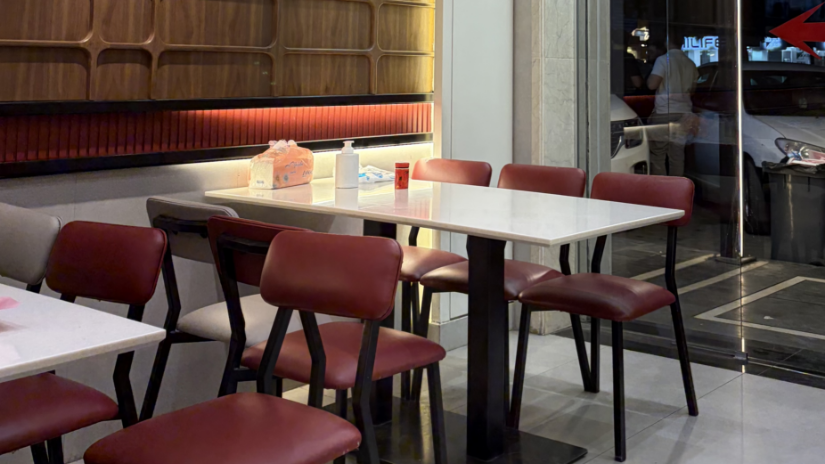
But I was not to be rewarded with this humble aesthetic reminiscent of a simpler time. The al-Firdous that I saw looked like a newly opened branch of an international fast-food chain: perfectly presentable but almost entirely devoid of character – not as soulless as a Prêt à Manger perhaps, but less interesting than a Shake Shack. Inside, burgundy-and-cream upholstered chairs surround terrazzo-effect tabletops mounted on black metal pedestal bases, while geometric wood-effect wall panelling, decorative latticework and warm pendant lights complete the refurbishment. The walls are conspicuously devoid of photographs that might have offered a glimpse of the restaurant's history: generations of proprietors, illustrious guests, or even the old Father of Grime in his less presentable days. Some of the old establishment's habits have nevertheless survived the transformation. A television still occupies pride of place on the wall, as it did before. There were no waiters hovering around the tables to take orders, and our dealings with the staff were limited to placing our order at the counter, behind which they were busy preparing the food.
One could perhaps understand why the proprietor of this longstanding establishment would want to shed some of its scales now that Syria itself is rebranding and entering a new chapter, with many who have a stake in the hospitality sector eager to welcome more tourists and Syrians returning from abroad. The owners may also have had another motivation. The restaurant has long been known among Homsis by another name: Abu Nishih, or Father of Grime. Hardly a Homeric epithet, this nickname, used more playfully than with disdain, likely derives from the establishment’s longstanding aversion to excessive fussiness about hygiene.
While the association with grime may today give the place an unappetising air, I remember, when a teenager, my peers singing the praises of such sandwich places, and that they were expressly known for their loose hygiene standards. Of all the times we commended our souls into God’s hands before digging into some dubious fare, I don’t remember any of us getting sick, and Homsi friends of mine agreed that the old Father of Grime did no more to compromise their health than the rustic drinking fountains in Syrian schools.
On my recent visit, I ordered the famous $2 toshka meal and an equally distinguished $1.44 fruit cocktail. The toshka came cut into several pieces, the flatbread bearing the dark parallel stripes of the grill, with melted cheese and minced meat enclosed between its thin layers. It was served on a tray lined with pink paper – which matched the colour of the plastic straw that came with my drink – alongside slices of tomato, pickled green peppers, a dollop of cream toum (garlic sauce) and some chilli paste.
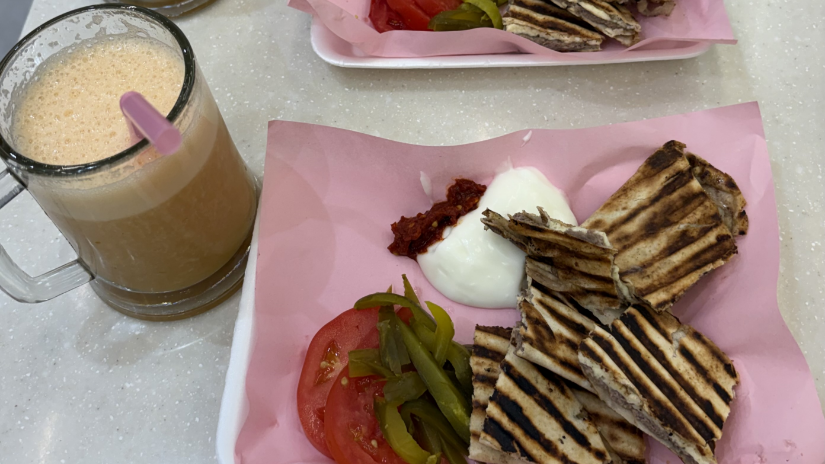
The filling, when exposed, was rather pale and unpromising, with the minced meat and cheese forming a bland-looking mass encased in soggy bread that did little to excite the senses. The taste was disappointingly bland, lacking both the richness of the meat and the satisfying interplay of flavours and textures that make a good toshka such a pleasure. A good toshka contains well-seasoned and slightly spicy minced meat and cheese that has melted into the meat rather than merely sitting alongside it, entirely enclosed in thin, crisp bread.
While I finished my meal without difficulty, I could understand the many comments I had read from locals who said it used to taste better. The portion would have been quite insufficient had I arrived properly hungry, although the satisfyingly thick and heavy fruit cocktail did help make up for the modest quantity of the toshka.
As I left al-Firdous, I reflected on how deceptive a polished exterior can be. The appetite for fashionable cafés and borrowed international aesthetics is hardly new to Syria, but fortunately many of the traditional haunts that survived the war have remained unchanged. However, there are dozens of new cafés and restaurants that are grotesquely out of place and they seem to be proliferating. These include a bright pink café with plastic plants on the Straight Street in Damascus and a SpongeBob SquarePants-themed ice-cream-on-saj establishment in Qemarieh, another old-city quarter. Meanwhile, some of Syria’s most prominent and expensive restaurants can be shockingly careless about both hygiene and the quality of their ingredients. In much the same way, the new Syrian government has been devoting considerable attention to appearances, leaving many citizens wondering whether the same care goes into what happens behind the scenes, and whether the eventual offerings will be quite as appetising as their presentation seeks to suggest.
I wish al-Firdous success with its new chapter. I have no doubt that the refurbishment was costly and it appears to have been implemented to a high standard. I regret, however, that it paid such little regard to al-Firdous’ history, and place in Homsi collective memory. Residents of a city that suffered so much horrific damage and loss during the war, deserve small pleasures associated with a happier past.
Toshka al-Firdous, Tripoli Road, near Safir Homs Hotel, Homs.