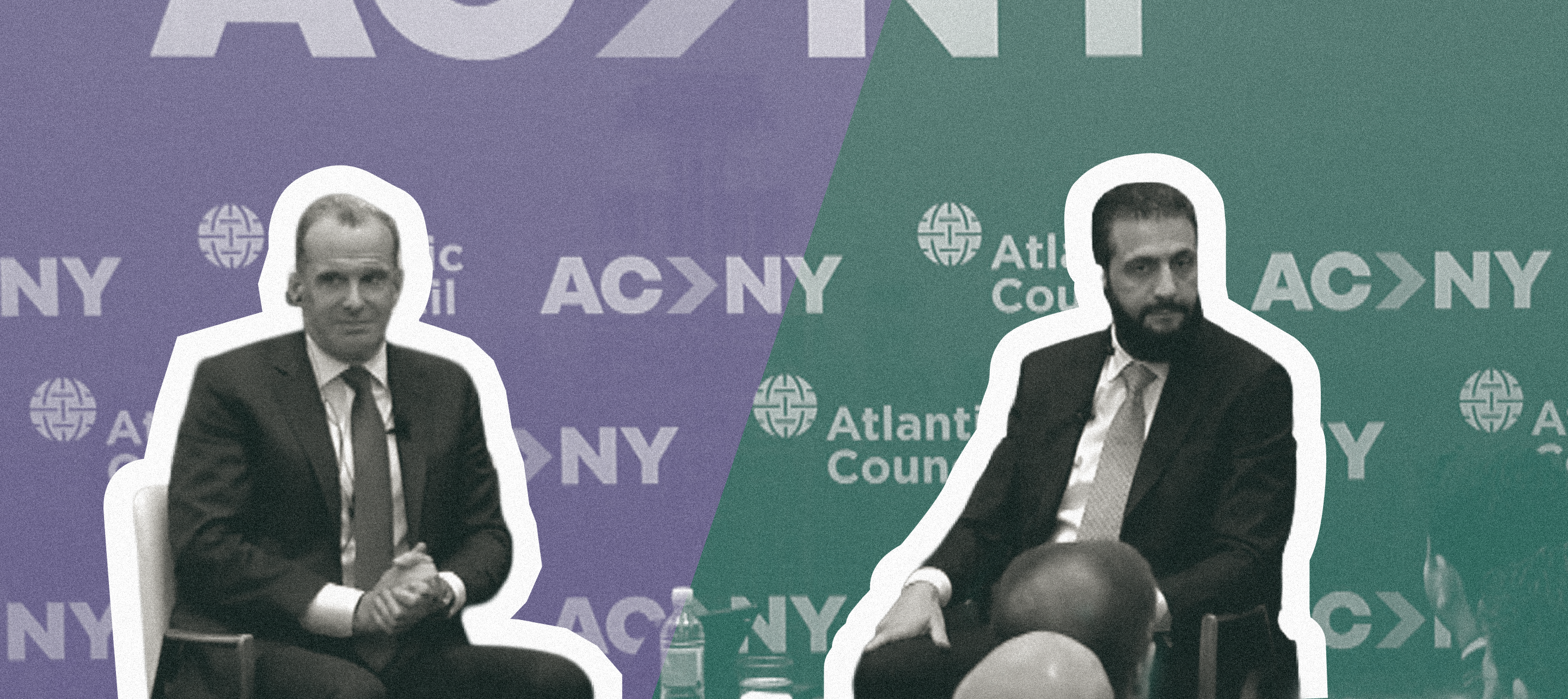
Al-Sharaa vs. McGurk
The UN General Assembly and the grammar of good and evil
On the sidelines of the UN General Assembly, Brett McGurk attempted to elicit a public disavowal of al-Qaeda from Ahmad al-Sharaa, who resisted and turned the tables. The encounter tells a lot about a fundamental difference between the US establishment and Syria under al-Sharaa that may prove irreconcilable.
From his victory speech at the Umayyad Mosque in December 2024 to his speeches before the UN General Assembly, Ahmad al-Sharaa has used the same conceptual grammar to illustrate the transition from old era to new: darkness, oppression and tyranny to light, dawn, freedom and justice. The recurring rhetorical motifs, first and foremost that of an eternal struggle between “good” and “evil”, have in fact become a staple; al-Sharaa the revolutionary casts himself as a fighter and custodian of the good, leading a just struggle against evil that requires force, but crucially not “bloodshed”, which is only attributed to the other side.
After good defeats evil
In his early speeches in the immediate aftermath of Assad’s overthrow, al-Sharaa identified the old regime and the international forces it brought to Syria on its side as the “evil”, keeping the latter vague enough to avoid uncomfortable questions about the continued military presence of Russia on Syrian soil. The Assad regime is framed as a distinct entity that existed almost like a separate organism or even an alien presence. It is never acknowledged that the regime was sustained, to varying degrees, by a critical mass of Syrians themselves – which is why transitional justice efforts are so complicated. Now that the Assad regime has been toppled, it becomes more difficult to define the “evil” when al-Sharaa states, as he did in his UNGA speech last month, that the struggle between good and evil continues. Who today is the good? Who is the evil?
There is certainly no shortage of so-called “regime remnants” as well as ISIS members and the occasional Hezbollah cell to provide fuel for the antagonistic machinery. The death sentence handed down to a former regime informant in late August for passing information suggests that the hunt could go on almost indefinitely: the mukhabarat penetrated Syrian society to such an extent that hundreds of thousands of Syrians could conceivably be prosecuted for informing on fellow citizens. Why informants are prosecuted and even sentenced to death while some senior regime figures and supporters are rehabilitated is causing considerable unease in Syrian society – the judiciary has not clarified the criteria.
Internationally, a binary antagonism is also difficult to sustain. Even adversaries such as Israel and Iran are difficult to cast simply as “evil” when al-Sharaa’s government is, understandably, talking to Israel, and suggested in late September that rebuilding a relationship with Iran would be possible if Tehran abandoned its previous policies. Antagonistic worldviews are as destructive as they are widespread, and are often accompanied by tightly woven conspiracy theories. The Assads mastered that art, and successive US administrations have, to varying degrees, also relied on antagonistic narratives to legitimise excessive violence. The aftermath of 9/11, the US creation of the “Axis of Evil” and the War on Terror are prime examples. Al-Sharaa witnessed injustice conducted in the name of justice first-hand as a young man when the US went on a rampage to avenge 9/11 by targeting Arab Muslims.
The tragedy of antagonism is that it has a habit of provoking the same in its victims, creating a self-fulfilling cycle in which the struggle between good and evil inexorably becomes eternal.
Whose truth, whose falsehood?
In his speeches before the General Assembly in 2025 and 2026, al-Sharaa emphasised the victory of “truth” over “falsehood”, quoting a Quranic verse: “Truth has come and falsehood has vanished. Indeed, falsehood is bound to vanish.” The famous verse is said to have been recited by Prophet Muhammad during the conquest of Mecca as he destroyed the idols that adorned the Kaaba. It was a liberating moment for the still young Muslim community after years of contempt and persecution at the hands of the polytheistic Meccans. It is a simple verse that takes something as politically messy as an internationalised civil war followed by revolutionary victory and attempts at state-building – all while the demons of the past and foreign interference persist – and places it within an absolute moral narrative of truth defeating falsehood.
At the UN General Assembly in 2025, al-Sharaa promised that Syria would continue its integration into the international community and restore its dignity. “Dignity” has been a keyword of the Syrian revolution from the beginning: it was what the Assad regime systematically denied, but what the human psyche needs, in one form or another, to survive. Dignity appears to matter deeply to al-Sharaa, which complicates the widespread portrayal of him as the ultimate pragmatist. The sense of injustice he felt, and the urge to confront it that took him to Iraq as a young man to fight the US occupation, do not appear to be things he has left behind. This may put him permanently at odds with the US political establishment, where the national trauma of 9/11 has largely been processed through an antagonistic narrative of its own.
Turning the tables
Generations of political and security officials have been shaped by the War on Terror, and many appear eager to see al-Sharaa as a fascinating case of redemption – one that would ultimately validate the righteousness of US hegemony. A case in point was al-Sharaa’s interview with David Petraeus last year, which SiT wrote about. This year, it was Brett McGurk, one of the architects of the flawed Syria strategy that narrowly focused on ISIS. At an Atlantic Council side event on 22 September, McGurk tried to use the stage to elicit from al-Sharaa an explicit public disavowal of al-Qaeda. McGurk invoked the anniversary of 9/11 and al-Sharaa’s past pledge of allegiance to Ayman al-Zawahiri, then bin Laden’s deputy. Al-Sharaa stressed that he had nothing to do with 9/11, but otherwise resisted the verbatim confessional box McGurk tried to put him in. Later, when McGurk asked al-Sharaa for a commitment to determine what happened to disappeared US journalist Austin Tice, al-Sharaa used the occasion to make a point on which he has been remarkably consistent. He said that he had met Tice’s mother, Debra, whom he described as a great woman, and had introduced her to his own mother. She, too, had lost her son for seven years – the years al-Sharaa spent in US detention in Iraq – and had believed him to be dead. The fact that al-Sharaa’s mother eventually found her son alive, he said, had given Tice’s mother hope. Al-Sharaa explicitly described theirs as similar stories.
It was a pointed comparison. He used the highly sensitive and emotional case of Austin Tice to remind an international audience that the United States itself had detained people for years while their families did not know whether they were alive or dead. At the time of al-Sharaa’s detention, McGurk himself served in the US government, including as Director for Iraq on the National Security Council and Special Assistant to President George W. Bush. Making that point before a US audience suggests how central the restoration of violated dignity is to al-Sharaa’s understanding of his own trajectory. He may tolerate and even utilise Trump’s perfume diplomacy, but this should not obscure his apparent conviction that the path of jihad he embarked upon was, in principle, a just response to injustice. Many victims of US intervention would recognise that argument; victims of al-Qaeda and other groups that committed crimes in the name of resistance may see it very differently.
In any case, an antagonistic worldview that thinks in categories of good and evil is poorly suited to achieving reconciliation. This applies on the international stage, where the currently warm relationship between Washington and Damascus is unlikely to last beyond Trump’s term. It also applies on the national stage, where reconciliation of Syrian society is fundamental to building a stable state. A constitution alone is no safeguard against authoritarianism – Assad’s Syria had one, too. What matters is the process of developing it: negotiating rights, limits on power and the rules by which political differences are settled. That process should be under intense scrutiny. Yet at the General Assembly, not a single government that spoke about Syria mentioned the constitutional process.