Play hard, trust no one
Lessons from the General Syrian Congress, 1919-1920
Syria’s first bid for statehood was earnest, constitutional and fatally misjudged. The General Syrian Congress trusted principles to offset hard power. A century later, the episode reads as a warning about how nations can fail at birth.
In 1919–1920 Syria attempted for the first time to emerge as a nation state. “Syria” was then still primarily a geographical expression in search of a political form, and encompassed what are now Syria, Jordan, Palestine, Israel, and Lebanon. The ambition to unite these lands under one polity was driven forward by Prince (later King) Faisal, son of Sharif Hussein bin Ali, the British-installed King of the Hejaz, who had helped in the collapse of the Ottoman Empire by launching the Great Arab Revolt.
Faisal was seeking the Syrian throne, and the mainly Sunni Arab soldiers, politicians and notables of Syria supported him. But he was checked by Great Power diplomacy – Sykes–Picot, San Remo, Sèvres – alongside other understandings involving Jews, Turks, Maronites, and Saudis that closed off the possibility of such an expansive state. Syria was reduced to a truncated version of Greater Syria, shorn of its western and southern appendages and occupied by France.
Syrians, however, did not acquiesce quietly. The attempt to resist this imposed settlement, and colonialism more broadly, however brief and unsuccessful, was the beginning of Syria’s political struggle to emerge as a nation state. At the heart of that struggle was the General Syrian Congress, a constituent assembly convened by Faisal in Damascus composed of notables and learned men from all corners of Greater Syria, tasked with defining the nation and deciding who should rule it, and how. It was the first time that Syrians had gathered as Syrians to plot their future. The birth of the Congress, its influence on events, and the constitution it agreed resonate strikingly in modern Syria, and offer valuable lessons on what to do and what to avoid when nation-building.
Appealing to the Allies
The General Syrian Congress was originally intended as a marketing tool for Faisal’s ambitions. Since he well understood that Syria’s fate would be decided principally by the victorious Allies - Britain, France, and the United States - it was conceived as a show of support for Faisal from Syria’s elites. The Congress was the brainchild of Rida al-Rikabi, a Damascene ex-Ottoman general and Faisal’s military governor (later first prime minister) of Syria, who saw that the post-war order demanded constitutional props to support claims to legitimacy: elected bodies, petitions, “programmes”, and basic laws.
The Congress first convened, at the Arab Club in Damascus, on 3 June 1919, just as the King–Crane Commission – America’s fact-finding mission to the former Ottoman provinces – arrived to solicit views on self-determination. Faisal opened proceedings with a statement of intent: the duty of the 107 delegates in attendance was to represent the country before the Americans, draft a Basic Law and agree explicit protections for minorities. The appeal was pure Wilsonian.
Its initial output, which later became known as the “Damascus Programme”, was adopted on 2 July 1919 and transmitted to King–Crane. It called for independence for Greater Syria, unity of the territories (including Palestine and Lebanon), and government “on broad decentralisation principles.” The Programme’s fifth article left the door open for an American or British mandate. “If the United States cannot accept our request for assistance, we ask for the assistance to come from Great Britain, on condition that it does not impinge on total political independence and unity.” In other words, anyone but France.
At one level, this was good politics. The Congress aimed to exploit American idealism as a counterweight to European colonialism. It framed Syria as a plural polity – embracing “Moslems, Christians, and Jews”, as the message to King–Crane put it – thereby pre-empting the standard French claim that only European tutelage could protect minorities. At another level, it was a profound miscalculation. American attention, as today, was fleeting. The commission’s findings were slow-walked; America had no appetite for confrontation with France; and the climax of Syria’s constitutional experiment, a formal declaration of independence reached on 8 March 1920, prompted a blunt French ultimatum: rescind the declaration or else.
Realpolitik vs ideals
Syria’s fortunes as a viable independent state declined precipitately with Britain’s withdrawal in July 1919, pursuant to Anglo-French arrangements. With British troops in Syria gone and French forces consolidating in Lebanon and along the coast, the Congress’s Wilsonian narrative and appeals to the United States and Britain appeared naïve. Faisal’s moderate, deal-seeking approach – essentially a bet on colonial restraint – lost domestic credibility when the San Remo Resolution, passed on 25 April 1920, placed Syria under a French mandate.
At the behest of the Congress – particularly delegates from northern Syria – Faisal requested help from Turkish leader Mustafa Kamal; but he had his own problem with the French, in southern Anatolia, and did not overtly assist. An armed insurgency along Syria’s coast against French forces ensued, followed by French invasion of Syria’s interior. On 24 July Syrian forces were decisively beaten at Maysalun, north of Damascus. Faisal’s war minister, Yusuf al-Azma, died in the battle after making a solemn pledge not to allow the invaders to occupy the capital without a fight. It was all very heroic; but a dismal failure.
The cautionary lesson is that appeals to ideals when not backed by force or other leverage are largely worthless – just ask the Syrian Democratic Forces. Like Faisal then, President Ahmad al-Sharaa today appears to believe that Syria’s fate will be decided principally by externals and not the will of the people, and that his best interests lie in an alliance with the US and the UK. Indeed, Sharaa has spent his first year in office seeking regional accommodations and international deals, capped by his visits to Washington and Moscow.
Constrained monarchy
Faisal was reportedly initially unenthusiastic about the idea of a General Syrian Congress, fearing that it would function as a proto-parliament and constrain his room for manoeuvre. As events unfolded, he was not entirely wrong. Much of the Congress’s membership comprised committed bourgeois Arab nationalists, many of them veterans of the secret anti-Ottoman Young Arab Society. These were idealists who had little appetite for compromise or accommodation with great power interests.
The more pragmatic wing of the Congress included figures close to Faisal, whose political fortunes were tied to his, as well as a small minority of openly pro-French delegates. Over time, however, the Congress tilted decisively away from pragmatism. The voices advocating accommodation with France – an outcome Faisal had been quietly pursuing with British support – were steadily drowned out.
This shift proved consequential. Faisal had been engaged in talks with the French prime minister, Georges Clemenceau, who felt a measure of moral obligation towards him on account of his contribution to the Allied war effort. Had Faisal been granted the political space to pursue a gradual pathway to independence under French tutelage, along the lines later embodied in the Franco-Syrian Treaty of 1936, Syria’s long-term trajectory might have been very different. It may have been closer to those of Jordan or Morocco: states that have been formally independent, Western-aligned and stable.
As it was, the Congress did see itself as a check on Faisal’s power. Its second president, Sheikh Rashid Rida, confronted Faisal after he had attempted to wrest control of the government. “You were just a commander serving under General Allenby. It was the Congress that made you King,” the Salafist cleric from Tripoli declared.
On 3 May 1920 the Congress voted to withdraw confidence from prime minister Rida al-Rikabi - a Faisal ally - and replace him with its own president, Hashim al-Attasi. The move did little to improve the situation. By 19 July 1920 Faisal had had enough. He called on the Congress to end its meetings, and signalled to General Gouraud, the French military governor in Beirut, that he was ready to negotiate terms acceptable to France. That day, the Congress issued a strongly-worded statement: "No government has the right to accept in the name of the Syrian Nation conditions that contravene the historic decisions of the Congress.” Six days later, French troops swept into Damascus.
The Congress failed to give Faisal the room for manoeuvre that he so badly wanted. It may have been a needed prop for visiting American delegations, and perhaps a useful sounding board, but it did not enable Faisal to conduct a more effective lobbying campaign. On one occasion Faisal was even blocked by the Congress from heading a diplomatic mission. The constant browbeating of the government by the Congress on military mobilisation served only to infuriate the French.
Fast forward to the present, and one can speculate on what might have happened had Sharaa established a genuine and inclusive constituent assembly with powers to oversee the government and draft a new constitution. On paper it sounds good, but it probably would have complicated diplomatic efforts.
Decentralisation as foundational principle
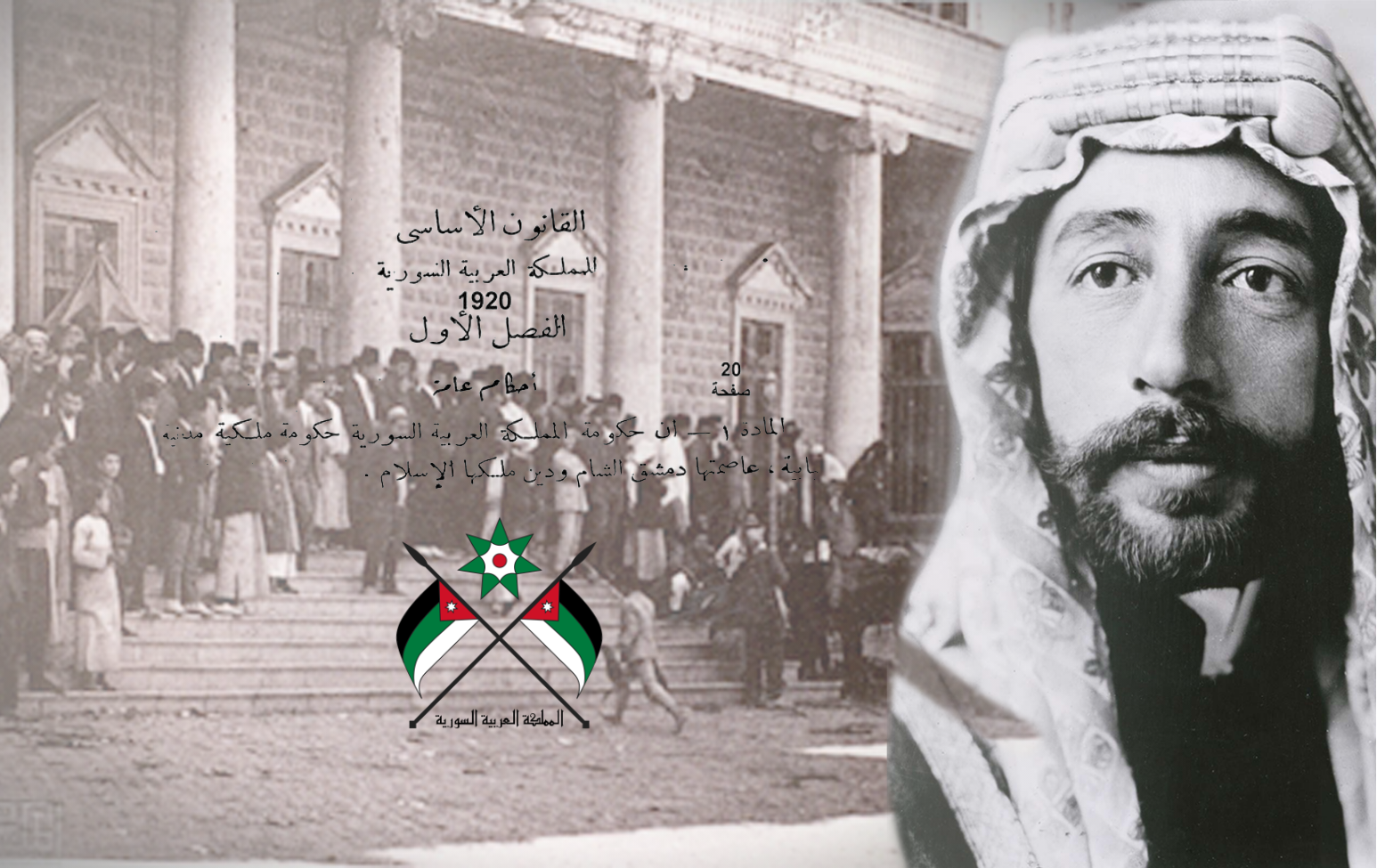
The Congress did prove adept in drafting a Basic Law – a reflection, perhaps, of the number of delegates who were lawyers. A ten-man constitution-drafting committee was elected, and by 7 March 1920 a 148-article constitution was adopted: Syria’s first. Article Two states: “the Syrian Kingdom is composed of provinces (muqata’at) that are politically unified.” Article Three stipulates: “The provinces are independent administratively as of this Law, and the Congress shall enshrine a Law that will clarify the borders of these provinces.”
The Basic Law stressed the importance of provincial decentralisation. Article 123 affirms: “The provinces will be administered according to extensive decentralisation.” Article 124 declares: “Each province will have its own chamber of deputies to inspect the province’s budget, and to pass laws and regulations according to its need, and to monitor the [local] government.” Articles 127 and 128 stipulate a two-year term for local assemblies, and for deputies to represent an average constituency of 20,000.
Subsequent articles go even further, setting out checks and balances between central and provincial authorities:
Article 132 - Laws enacted by the provincial representative councils are submitted by the governing ruler to the King for ratification and order of implementation. The King must ratify them, and they are returned to the provinces within one month.
Article 133 - If laws submitted by the provinces are returned without the King's ratification, on the grounds that they violate the constitution or general laws, the provincial representative council shall reconsider them. If it insists on the original form and the King does not ratify them a second time, the Senate shall rule, and its ruling shall be final.
To many Arabs in Syria today, "decentralisation" remains a suspect term. Granting autonomy to regions or minority groups is often seen as an open invitation to ever-greater demands on the centre, fostering chronic internal tension and exposing the country to foreign meddling. At the moment of Syria’s birth, however, decentralisation carried no such stigma. On the contrary, it was widely regarded as a mark of good governance and a practical means of holding together a diverse polity – so much so that it was enshrined in the country’s first constitution as a foundational principle.
All this suggests that Syria’s founding fathers imagined Syria to be more of a “union of provinces” held together by a central government that retained significant powers over defence, finance, and foreign policy, but that left much of the day-to-day to local governments accountable to local assemblies. It’s a model that may now be evolving in Syria: in Kurdish-majority regions and in Suwayda, and possibly other regions that have a "particularity” warranting special status. The precedent is there in the constitution of 1920.
Different type of skills
Liberals instinctively welcome constituent assemblies. They signal consensus, dialogue and inclusion. They are well suited to drafting constitutions and conferring legitimacy. The General Syrian Congress did all of that, and did it with seriousness and intent. It was a “democratic” institution that might have functioned well had there been no existential threat to the new state. At moments when speed, discretion and ugly compromise were required, the Congress imposed deliberation, publicity and maximalism. Syria’s earliest experience of nationhood suggests that building a state in a hostile environment demands a more acute reading of power politics and a sharper skillset than that offered by the distinguished gentlemen who gathered at the Arab Club in June 1919.