Let’s talk about aid
Western aid is a crucial power factor in Syria
Constrained Gulf budgets in the wake of the Iran war are worsening Syria’s already bleak prospects of moving beyond aid dependency. Donors, the UN and Damascus have a lot to discuss.
As President Ahmad al-Sharaa emphasised in a speech after Eid prayer, Syria is on a path of development and reconstruction. Like most things, this is a matter of perspective. The utterly bankrupt Assad regime set a very low bar, and despite some progress, more than 16 million Syrians remain dependent on aid - according to UN figures - and are likely to remain so for years to come. It is Western donors who will take centre stage in footing the bill.
The bulk of Western aid is delivered through the United Nations, which effectively functions as an aid middleman - or rather a collection of competing ones. As long as the Assad regime was the recognised government, humanitarian principles meant that engagement with the state was to be kept to a minimum. The UN would conduct needs assessments, set priorities and coordinate response plans, while implementation was largely undertaken through NGOs. This arrangement was undermined by the Assad regime, which forced implementers to “partner” with the Syrian Arab Red Crescent or the Syria Trust for Development, both run by its cronies. It was also undermined by parts of the humanitarian community, which — for the sake of business or access, depending on definitions — engaged with the government more than necessary; and by some donor governments that flirted with normalisation and encouraged cooperation to create humanitarian facts that could later be translated into political assets.
Now, with Assad toppled and a new government in place, the discussion has quickly shifted from life-saving aid and NGO-led early recovery towards development and reconstruction within a state-led framework. One reason is the reframing of Syria as a post-conflict setting, which the new authorities in Damascus are keen to promote as it reinforces their claim to legitimacy. Another is that development and reconstruction naturally place the government in the driver’s seat. After years in which the Assad regime hijacked the aid architecture — and in which the UN allowed itself to be hijacked — the new government is deeply sceptical of the UN and has kept it at arm’s length. As is becoming increasingly clear, however, they need each other: UN agencies want business and relevance while the government needs international support.
‘Statement of Recovery Priorities for International Cooperation’
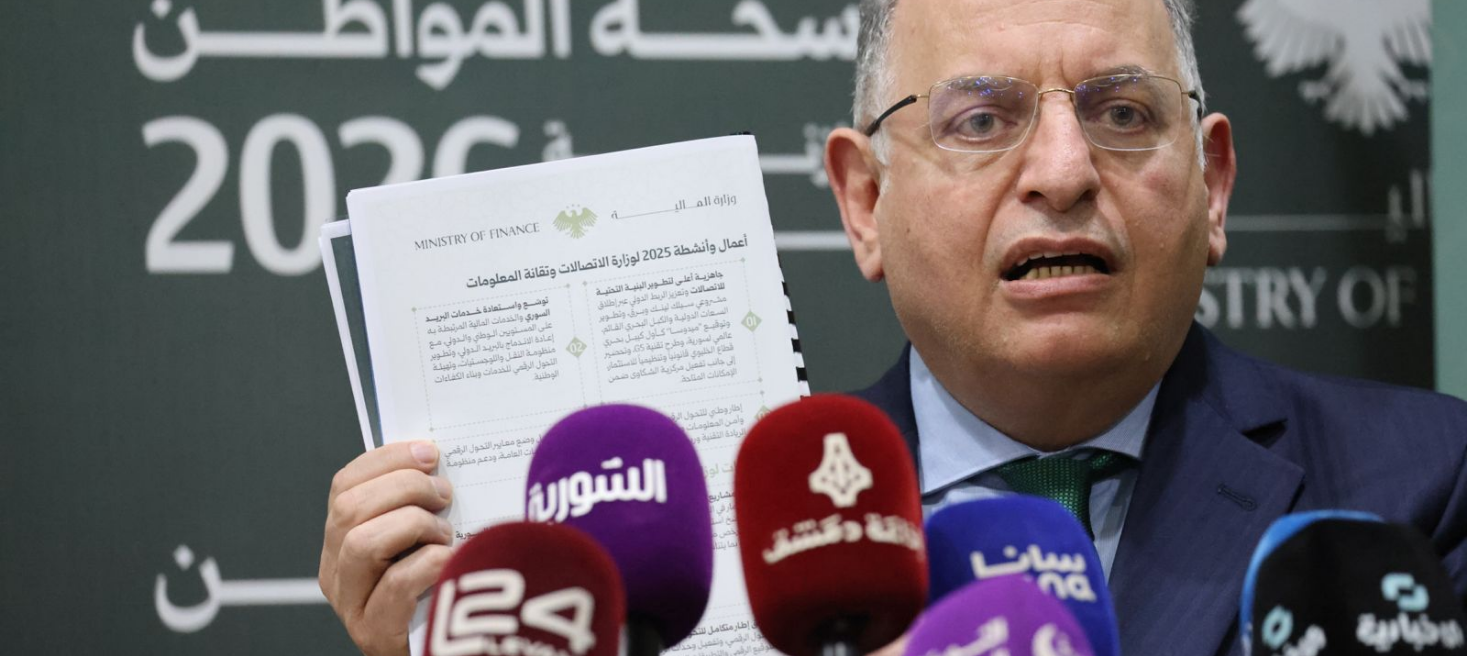
Enter the Syrian government’s “Statement of Recovery Priorities for International Cooperation”, finalised in March. This sets out what aid should focus on and how it should be delivered, and the government expects the framework to be reflected clearly in the strategies, workplans and funding proposals of international partners. Interventions are to align with four priority areas: restoring critical infrastructure, resuming basic service delivery, building social and economic resilience and supporting “core systems” — i.e. state institutions and public administration. The message is explicit: aid must strengthen the state.
When drafting the plan, the new authorities in Damascus may have been inspired by a familiar UN practice in Syria: blurring the lines between humanitarian and development assistance to avoid constraining mandates. Framed as “recovery” and as a “transitional phase toward sustainable development”, the plan folds the two into one — despite the very different political contexts in which they operate and the distinct rules meant to govern them. In practice, this risks subordinating humanitarian principles to the objective of strengthening the state, as defined by Damascus. If a state fully embraces those principles, including their human rights focus and commitment to needs-based programming, there is no issue; but humanitarian principles were designed precisely because such alignment is rare.
Aid is power
While the government plan is unsurprisingly state-led, it portrays a state that does not yet exist. Syria remains fragmented. State institutions are still works in progress, and the government lacks electoral legitimacy. International assistance, both humanitarian and developmental, remains a key resource in an ongoing process of power consolidation. Whether donors are ready to give up independent assessments and delivery modalities in such a context remains an open question.
The plan also establishes the International Cooperation Department within the Ministry of Foreign Affairs and Expatriates as the sole national platform for coordinating all forms of international assistance. While this centralisation fits a state-led model, humanitarian actors typically coordinate with state authorities while maintaining operational independence, often through structures such as the UN Country Team or other, non-UN, funding mechanisms such as the Aid Fund for Syria (AFS). Sources in Damascus say that Foreign Minister As’ad Shaibani is centralising control over aid in order to consolidate his position within the HTS-led power structure. The Ministry of Social Affairs and Labour, headed by Hind Kabawat, is reportedly not happy about this concentration of authority and donor access and the friction is said to be one reason why she may be on her way out.
The good old HDP Nexus
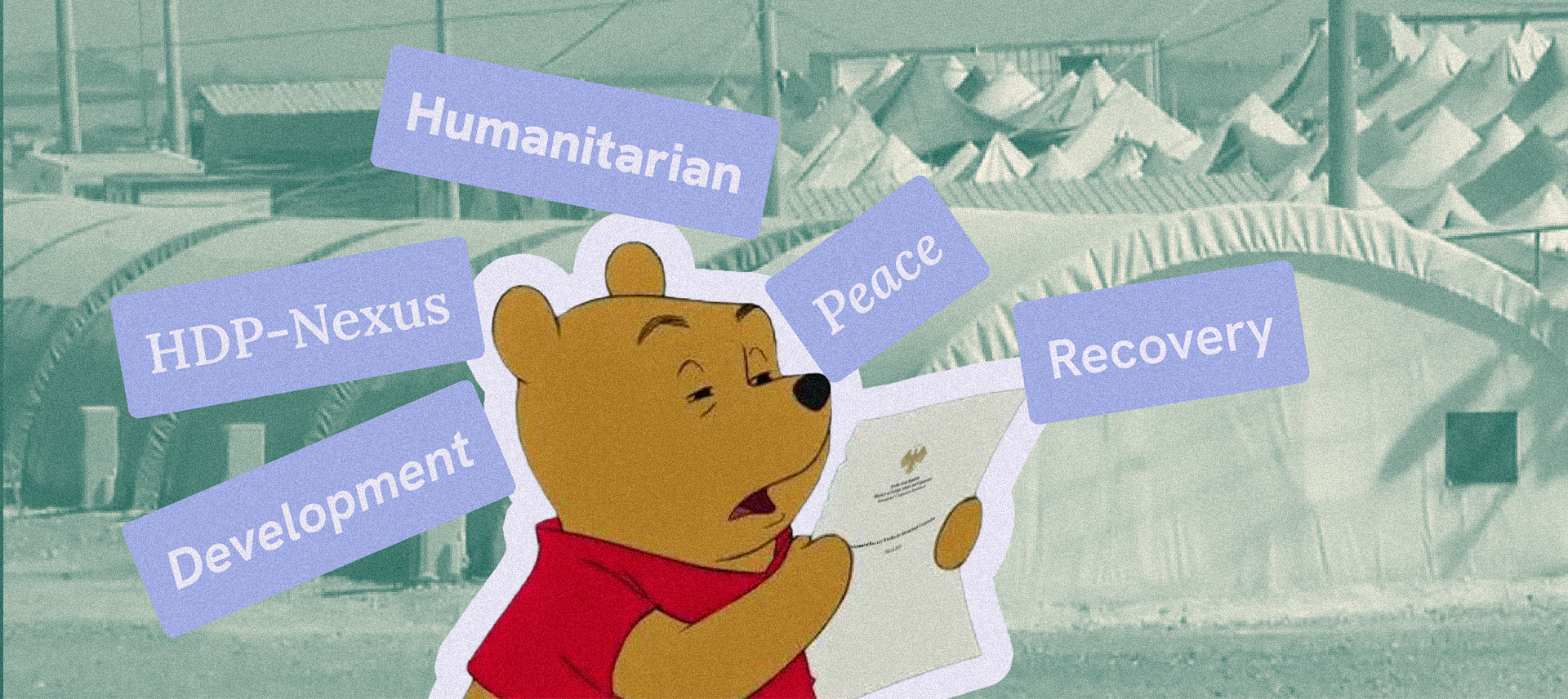
Fortunately, all actors have formally committed to the Humanitarian–Development–Peace Nexus (HDP Nexus). The government framework highlights it, as do UN strategies and donor documents. The European Union, for example, has launched a Nexus Response Mechanism, implemented by UN Office for Project Services (UNOPS). The four-year, €31.5 million programme aims to “reduce vulnerabilities and strengthen community resilience” through socio-economic recovery, local governance, capacity development and infrastructure. Partnership with Syrian authorities is built into the design; but what this partnership will look like in practice remains unclear. UNOPS habitually respects donor priorities. Will the programme include salary payments to government employees? Will it be guided by political risk and conflict analysis?
“There is, frankly, a near-total lack of coordination among UN agencies,” a UN official told Syria in Transition. “Initiatives by UNOPS and others are not part of a coherent, unified strategy.”
Unfortunately, the HDP Nexus continues to suffer from familiar problems. It sounds good, it ticks boxes in strategy documents, but there is little agreement on how it should actually be implemented. Its “peace” pillar has been reduced to vague notions about local stabilisation, resilience and service delivery. It ignores core political questions: how aid reshapes power relations; how it reinforces formal and informal elites; who it legitimises, and who it excludes. In short: what it means for Syria’s transition.
Deputy Special Envoy Claudio Cordone (the UN has not appointed a new Special Envoy to replace Geir Pedersen since he left office in October 2025) told Syria in Transition that, from the perspective of the Office of the Special Envoy (OSE), “the peace pillar of the HDP Nexus in Syria extends beyond local stabilisation efforts or service delivery. It encompasses resource sharing and in general the broader conditions necessary to reduce or prevent conflicts, promote social cohesion and support a sustainable political settlement.” He added that, “the efforts of the UN country team and of the OSE are complementary and share the same goals: that of a successful transition that will benefit all Syrians.”
These are commendable ambitions, but moving them from rhetoric to action requires serious political risk and conflict analysis, risk management mechanisms and clearly defined objectives, as well as the will to act. Under Assad, the reference point was UNSCR 2254, with its emphasis on an inclusive transition, UN-supervised elections, human rights and countering terrorism. Donors now need to clarify whether these principles still guide their engagement, whether they align with official Syrian policy and whether they are ready to place this issue on the Security Council’s agenda. It may be tempting to postpone that conversation. But even if the HDP Nexus is understood in its most minimal sense — as improved coordination between agencies — it still requires a political framework that clarifies goals, roles and red lines. Without that, the UN in Syria would be little more than a competitive pool of middlemen with a concerning track record on coordination, use of resources and independence.
OSE to the rescue?
Under UNSCR 2254, the OSE has an important role to play in moving the HDP Nexus and related discussions forward. On 17 March, however, Claudio Cordone briefed the Security Council in a tone that, had a mischievous intern replaced the UN logo with that of the Syrian Foreign Ministry, might have gone largely unnoticed. The language and substance differed markedly from previous briefings by Najat Rochdi and Geir Pedersen, despite the UN’s own Commission of Inquiry reporting ongoing serious violations across multiple parts of Syria, including extrajudicial killings, arbitrary arrests, sexual violence and property seizures. Yet in Cordone’s briefing these were flattened into a polite formulation: “persistent concerns” alongside “positive steps.”
It may be understandable that Cordone is seeking to build a positive working relationship with Damascus while the office is trying to secure a relocation to the Syrian capital. The mood is certainly one of “let’s move on,” and that creates a gravitational pull toward optimism. But the job of the UN’s political pillar is not to be optimistic. It is supposed to be a credible referee. If UN member states prefer an OSE that smoothes rough edges rather than engaging in conflict analysis and difficult diplomacy - including on aid - they may as well shut down the office and save its annual budget of roughly $15 million.
Unused potential
Global aid budgets are shrinking, and many donors are increasingly explicit that aid should serve their national interests. If aid is moving from being an implicit to an explicit tool of diplomacy, that is a strong argument for reforming the aid architecture. As things stand, there is little method in the madness; and a great deal of unused Western leverage that could be deployed to safeguard principled, life-saving operations while aligning them with more strategically-driven development efforts.
Importantly, the new authorities are not newcomers to the aid system. Years of governance in Idlib have produced a cadre of officials with hands-on experience managing aid and dealing with international actors — often from the receiving end. That experience cuts both ways. It equips the current administration to shape the system to its advantage. At the same time, however, it could provide a basis for a more constructive partnership. Which path prevails will depend on incentives, and on whether donors are willing to use their potent leverage.