Armenian Aleppo, one plate at a time
A restaurant review of Abu Hagop in Aleppo
Our restaurant critic Nadim al-Sufra explores the city’s Armenian heritage – and what better way to do so than over traditional food.
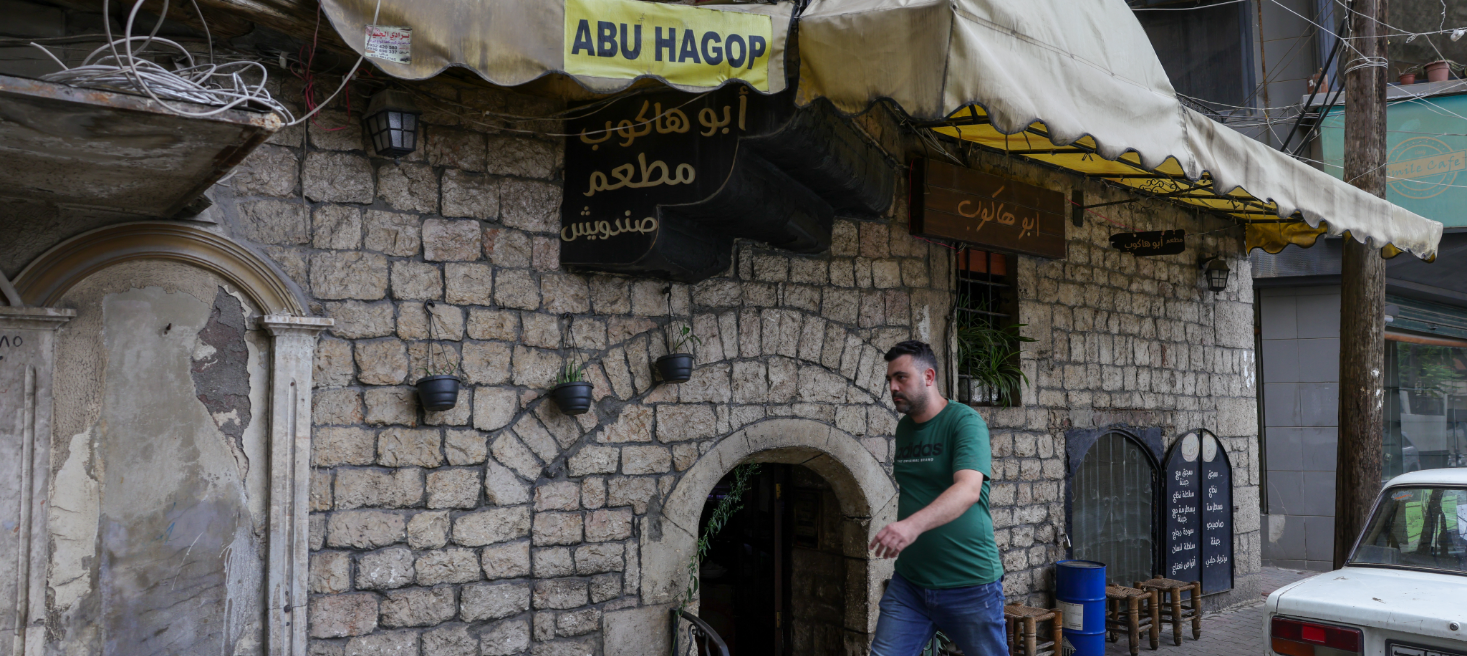
I never fail to visit Abu Hagop when I am in Aleppo. The small Armenian eatery stands in the predominantly Christian neighbourhood of Azizieh, across from the Homenetmen Armenian social and sporting club and not far from the Armenian General Benevolent Union.
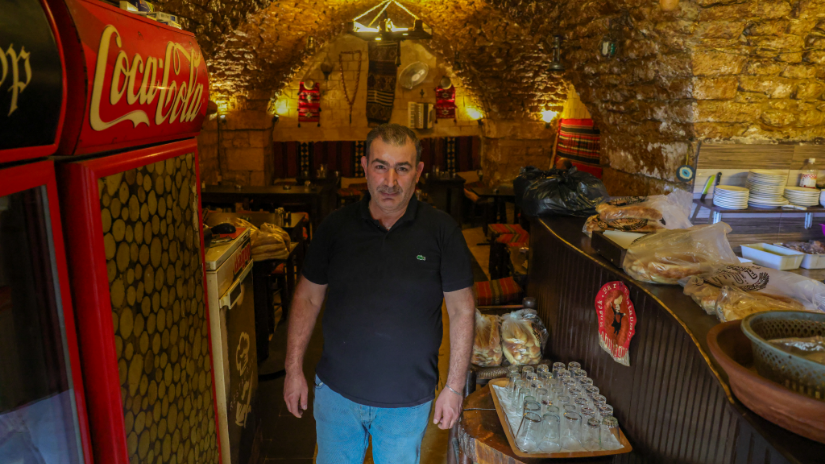
Few things are more characteristic of old-school Armenian Aleppo than cured, spiced meats. Abu Hagop occupies the ground floor of an old stone building. A low-arched black door, a canvas awning and modest signs in Arabic and English mark its entrance. Customers descend a few steps into a narrow dining room with heavily glazed stone walls and a vaulted ceiling. Dark wooden tables are surrounded by low stools with red patterned cushions, and assorted trinkets hang on the walls. At the back, two Armenian men work behind a small, open food-preparation counter. The room is compact, dimly lit and plainly furnished.
Abu Hagop’s manager is Maher, who comes from Maabatli, a largely Kurdish town whose inhabitants are predominantly Alevis. He has an air of innocent mischief about him and more than a touch of satire. He loves customers who know what the restaurant offers and what they want to have – and who do not attempt to book an all-male table on Thursdays and Sundays. Many restaurants in Aleppo apply this customary door policy by making sure all bookings are made for “families”, meaning a mixed or all-women group.
Aleppines are particularly fond of entrusting their stomachs, cars and jewelry to this mother of all Armenian diaspora communities.
“The Kilislian family sold the restaurant and left in 2014,” Maher told me when I returned to Abu Hagop on my first visit back to Syria in 2025. “But don’t worry, the new proprietors are also Armenians,” he quickly added. He knew this was all the reassurance I needed. Aleppo’s Armenians have a reputation for skill and devotion to whatever profession they pursue. Aleppines are particularly fond of entrusting their stomachs, cars and jewelry to this mother of all Armenian diaspora communities, notwithstanding their considerably broader contribution to Aleppo’s intellectual, political, and cultural life.
The number of Armenians living in Aleppo greatly diminished during the war. At the end of the nineteenth century, there were approximately 4,500. Those established there before the Great War (1914-1918) came to be known as the ‘Arman Qadim', or Old Armenians. They were joined after the 1915 massacres by a great influx of survivors and their descendants. Aleppo’s Armenian population was estimated at 60,000 when the first cries of the Syrian revolution sounded. Today, it is commonly placed at between 10,000 and 12,000. Armenian Apostolic, Catholic and Evangelical churches, schools, social clubs and eateries still pepper the city.
After drinks are ordered verbally, Maher usually gives me the pen and paper to write down the order while he hovers restlessly nearby. It is one of his best shows of trust in a regular customer. On a recent September evening, my friend and I ordered an olive salad and a fattoush, followed by thin slices of pastirma (heavily seasoned, air-dried cured meat), sujuk (spiced Armenian-style beef sausage served at Abu Hagop in the form of sandwich pieces), kebbeh nayyeh (pounded raw meat mixed with fine bulgur and spices), aqras na’na’ (small patties of minced meat and fresh mint, served with a dressing of lemon, garlic and olive oil), Kurdish cheese (salty white cheese served in flatbread with chopped hot green chilli and tomato), and Toshka (a flatbread filled with minced meat and cheese, then toasted until crisp outside and melted inside). We were also offered a lamb tongue sandwich on the house.
The food takes forever to prepare at Abu Hagop, and it is therefore better not to visit the restaurant when already on the brink of expiring from starvation. The two chefs behind the bar like to take their time to prepare everything properly, gamats gamats, as Armenians say – slowly, slowly.
Abu Hagop has not changed much since I started frequenting it in the 2000s with friends, at a time when we were still exploring going out to eat and drink on our own. We would go to an intellectual café in Villat to study, then take lunch at Abu Hagop.
Abu Hagop still attracts all sorts of interesting people, and the end of the night sometimes still brings them together in intellectual discussion or displays of good-natured banter.
Antranig and Azniv Kilislian are said to have opened the restaurant in 1957, just one year before Syria jumped into its ill-conceived and short-lived union with Egypt. Their surname implies their origin from Kilis. In keeping with Middle Eastern tradition, Antranig was also called Abu Hagop, the father of Hagop, his only son.
Hagop – Armenian for Jacob – took over the restaurant from his parents, and continued to run it until the family left Syria for Armenia. There, they opened a restaurant and sandwich shop – also named Abu Hagop – on Pushkin Street in the capital, Yerevan. This is now run by the third-generation Kilislian brothers: Antranig, George, and Serop.
Despite the change of proprietor and the war years, the Aleppo restaurant is still in fine form, and remains a favourite haunt of many a saheb marāq, or person with an appetite for good living, in the highly picky culinary capital of Syria. We ate with great merriment, nibbling slices of pastirma as readily as salted nuts as everyone at the restaurant joined in the choruses of Melhem Barakat’s intoxicating songs. Abu Hagop still attracts all sorts of interesting people, and the end of the night sometimes still brings them together in intellectual discussion or displays of good-natured banter.
It is rarely pleasant to discover how much is due after a hearty meal at a restaurant, but that is not so at Abu Hagop. A total of $23 for the entire table almost makes one wonder whether Maher had failed to include certain items in the bill, especially for an establishment aware of its fame and reputation in these times of ceaseless inflation.
Abu Hagop, behind Shams gas station and the Homenetmen Club, Azizieh, Aleppo. Reservations: +963 991 185 188.