Political theatre by a political performer
The Revival of the Al-Hamra Theatre under Nawar Bulbul
Private donations raised the $30,000 needed to renovate Syria’s historic Al-Hamra Theatre in Damascus. It reopened in September under actor and director Nawar Bulbul, who has ambitious plans to usher in a new era of Syrian theatre, including Syria’s first International Theatre Festival in 2027. His conviction that artistic expression – including its political dimensions – should be free will now be tested on the public stage.
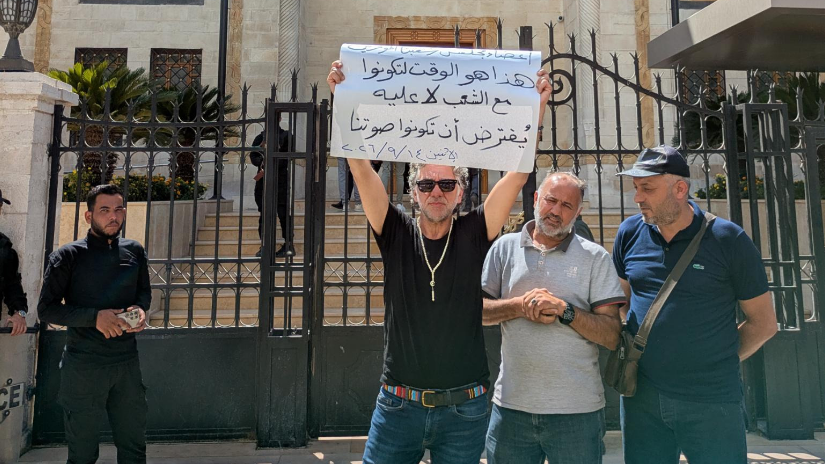
Politics, it seems, burns just as brightly as theatre as an animating force in the life of Nawar Bulbul, the Syrian actor and theatre director who is now ten months into his tenure as director of theatres and music within Syria’s Ministry of Culture. Just ten minutes before a pre-arranged meeting with the 53-year-old at Al-Hamra Theatre, Syria in Transition chanced upon Bulbul’s tall, slender figure holding aloft a handwritten sign in front of the gates of the People’s Assembly on Al-Salihiyah Street. It read:
‘Venerable members of our People’s Assembly. This is the time to be with the people, not above them. It is incumbent that you be our voice. Monday, 14/9/2026’.
A small crowd had gathered to watch the spectacle as Bulbul moved back and forth between the gate and the street and interacted with security guards and a suited man inside the compound. Neither the suited man – presumably the head of security – nor the guards seemed particularly concerned by the solo demonstration, which took place the morning after Syria’s transitional government announced significant fuel price increases, precipitating demonstrations across the country. Smiles and banter were even exchanged. It was a confident performance by an actor accustomed to the stage, and with a long pedigree of mixing theatre and politics.
Shortly after the protest, Syria in Transition sat down with Bulbul for an interview in Al-Hamra’s foyer. Following six months of restoration works, the theatre reopened officially four days later.
Bulbul’s journey from graduate of Damascus’s Higher Institute of Theatrical Arts in 1998 to Syria’s director of theatres and music was circuitous. After establishing himself as an actor and theatre director in Syria in the early 2000s, and participating in many international theatrical tours throughout the decade, Bulbul became an activist during the Syrian uprising in 2011, his actions including leading a chant for freedom at the funeral of Fayez Al-Sa'our, who was reportedly beaten to death by Assad security forces at a checkpoint in July 2011. In 2012 he was blacklisted by the regime. Later that year, he put on a theatre show in secret called I Love Her (‘uhibuha’), which dealt with the uprising’s outbreak. The regime caught wind of the production and shut it down.
“After that, I was subjected to a great deal of harassment and pressure, to the point that I ended up under house arrest”, Bulbul explains. “At the end of 2012, I was summoned by the regime, by the intelligence branches, but managed to escape Syria at that point. I fled to France. My wife is French, and we had a newborn son.”
After fleeing to France, Bulbul’s historian wife found a position in Jordan and the family relocated again. In Jordan, Bulbul produced three plays, two of which, he claims, attracted the ire of the kingdom’s intelligence service and were shut down. After four years in Jordan, Bulbul returned to France where he remained until the fall of the Assad regime provided an opening for the self-described Francophone to return to his homeland in 2025.
Restoring Al-Hamra
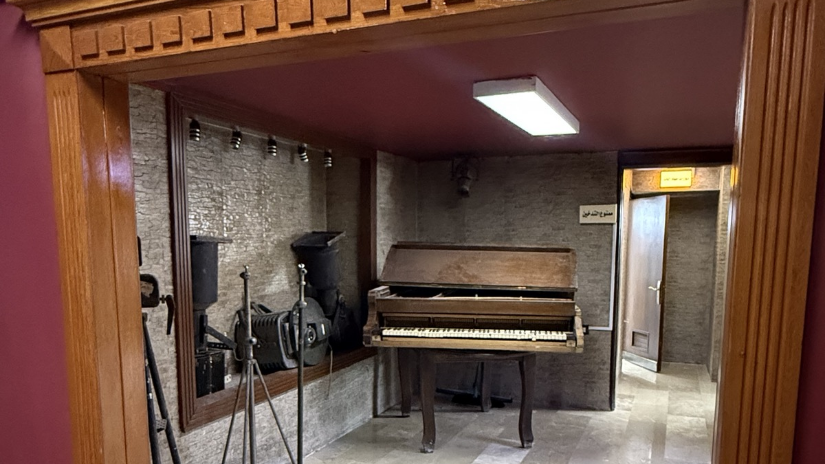
Bulbul is emphatic about Al-Hamra’s significance: “Al-Hamra Theatre is one of the oldest and most well-established Syrian theatres. It dates back to 1960, before the Baath Party. Our goal [with the restoration] was to return it to the state it was in before the Baath Party. So we pulled out the old piano and the original equipment – even the original stage curtain – and we will use it again.”
The first theatrical production at Al-Hamra, in February 1960 and directed by Rafiq al-Sabban, was Aristophanes’ Assemblywomen. The venue was then a cinema and rented by Syria’s National Theatre before being formally acquired by the Ministry of Culture several years later. In Syrian theatre, the three-year period between the establishment of Syria’s National Theatre in 1960 and the Baath Party coup in 1963 was internationalist, with productions heavily focused on Western works. Other classics performed in this period (though not all at Al-Hamra) include Camus’ The Just (al-Sabban), Molière’s The Bourgeois Gentleman (Nehad Qalei), Gogol’s The Government Inspector (Hani Ibrahim Mansour), Oscar Wilde’s Lady Windermere’s Fan (Mansour), and George Bernard Shaw’s The Man of Destiny (Mansour).
Bulbul described the theatre as having been “unfit for humans” before the works. A week before our interview, Syria in Transition toured the theatre with Muhammed Jundiyeh, an actor and administrative officer within the ministry’s theatres and music directorate, who had an operational role in the redevelopment. “All of this equipment is new”, Jundiyeh says, pointing to a bench of sound and light control boards as we toured the theatre’s control room. “Before the refurbishment, all that was here was this”, he continued, gesturing to a tangled array of cables and power plugs in the corner.
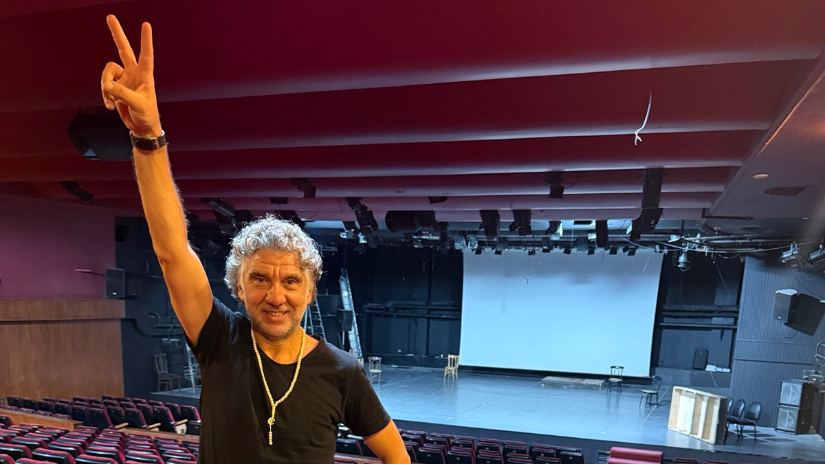
The 485-seat auditorium and stage also underwent a transformation. Old synthetic armrests were replaced with wooden ones engraved with the theatre’s most famous line: “nkoun aw la nkoun” (to be or not to be). Rooms located behind the stage were dismantled to double the stage area and enable larger productions. New stage lights were installed, an accessible ramp was built to enable direct access from the street, and internal walls were repainted to match the theatre’s original design. “We found old photos of the theatre from before the time of the Baath Party. We colour-matched the paint from those photos to return the theatre to its original look,” Jundiyeh explained.
Muhammed also showed Syria in Transition a small storage room located off the renovated basement directly under the control room. It was crammed full of old, dusty stage props, and an old motor scooter. “This room we left as we found it. We will leave it as it is as a testament to the neglect of the theatre before the liberation.”
Private support for a public theatre
Like most cultural institutions globally, philanthropic support played a role in Al-Hamra’s redevelopment. According to Bulbul, the total cost was $30,000. “All of these improvements were done through donations from businesspeople, friends, and lovers of the theatre. People want to see the country rebuilt. Some donated fifty dollars, another one hundred dollars. One gave five thousand, another six thousand.” One of the Syrian businessmen who donated to the theatre’s restoration was present at Al-Hamra during Syria in Transition’s visit. When asked about his relationship to theatre, the businessman replied: “I have no relationship to theatre, but I wanted to help Bulbul.”
Bulbul says that the Ministry of Culture had told him that funding would be available for the redevelopment the following year (2027), but he insisted that the work could be done much more cheaply than the Ministry’s estimates, and that work could begin immediately through philanthropic donations. Bulbul is also open about wanting to bypass government bureaucracy and the government committees responsible for approving various aspects of the redevelopment. The Minister of Culture, Mohammad Yassin Al-Saleh, ultimately accepted Bulbul’s approach. It was a story Bulbul repeated publicly five days later at Al-Hamra’s relaunch, with Al-Saleh present in the audience.
Bulbul insists that donors to the redevelopment trusted him to use their support honestly, and that his record as a revolutionary from 2011 gives him kudos in this regard. He also insists that the donations were philanthropic in the true sense of the word, with the donors simply keen to support art and with no expectation of any quid pro quo. The desire to act swiftly in the face of government red tape is certainly understandable; but the bypassing of the public bureaucracy in such a manner might raise governance questions.
Now that Al-Hamra’s restoration is complete, Bulbul and his team are focused on restoring the nearby Al-Kabbani Theatre, and there are ambitions to undertake similar works at public theatres across the country.
“Theatre: For Everyone” – a new guiding philosophy
When asked about his vision for Al-Hamra and public theatre generally in Syria, Bulbul reveals an egalitarian ethos – perhaps a product of his Francophone influences.
“When I first took on the role of director of theatres and music, I had a motto: theatre for everyone. Publicly owned and produced theatre for everyone. Without censorship. Removed from sectarianism and racism, and from contempt for religion and women.”
“I participated in the Avignon Festival four times. I saw how theatre was in Europe. Avignon is the biggest market of theatre in the world – we’re talking about 1,800 plays. You might see a play you don’t like, but someone else will like it. It is theatre for all. So that’s the idea I want to promote here: how do we put on theatre for everyone? For all the people, not just for the intellectuals. All the people, all the classes.”
Theatre, of course, is not to everyone’s liking even at the best of times; and with Syria now in a deep economic crisis and the UN estimating that 90 percent of the country’s population lives below the poverty line, it is an open question how successful Bulbul will be in his ambition to attract theatre goers from beyond the socio-economic elite.
Telling Syrian stories
Telling distinctly Syrian stories is also high on Bulbul’s agenda. Following 61 years of Baath Party and 53 years of Assad-family rule, there is now an opportunity to produce theatre shows free from state interference or censorship. When asked about this, Bulbul becomes animated. “Let me show you something,” he says, flipping through the photo gallery on his mobile phone. “Look at this treasure.” He holds up his phone screen to show a close-up photo of a handwritten label affixed to a file cover. It reads: ‘Texts banned from performance: 2005-2010’. “I found this in a box in the storeroom”, Bulbul says. “God willing, we can do a festival around this: plays that were banned from performance.”
Opening Syrian theatre to the world, while supporting local talent
While telling Syrian stories is high on Bulbul’s agenda, so is opening up the Syrian theatre scene to the world. “All of the work we are doing is to prepare for what will be the first Syrian International Theatre Festival, which we will run next year, probably in May.” Plans are already underway for this, with Bulbul leveraging his connections with ambassadors from France, Ukraine, the Czech Republic and Japan. Such festivals and other international theatrical tours hopefully will provide opportunities to develop local capacities.
“Next year a French production of Molière’s Tartuffe will be touring Syria. I invited them to tour with one condition: that they conduct a workshop with the students – actors and technicians – at Higher Institute of Dramatic Arts.”
The motto “theatre for everyone” is not only a reference to Syrian audiences. It is also a reference to Syrian actors. “We made them a theatre, a place worthy of them, where they can sit, drink coffee, talk, socialise,” Bulbul says.
A new era of Syrian theatre?
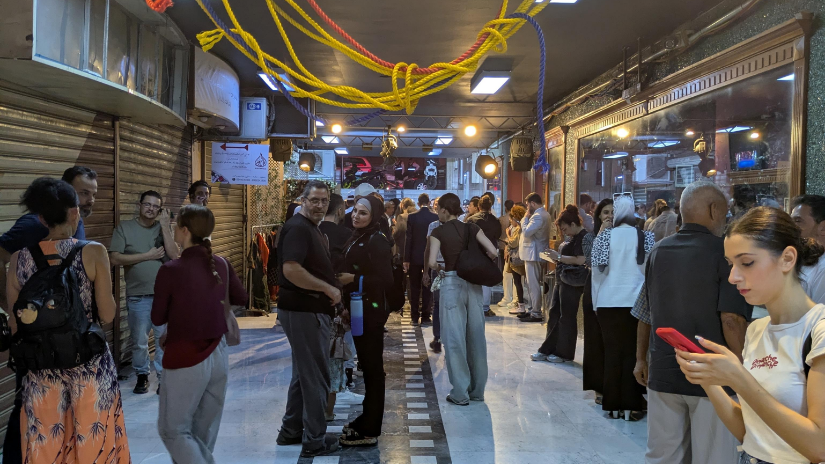
Al-Hamra’s relaunch event was attended by well-known Syrian actors and theatre directors and many of the donors who provided financial support for the theatre’s redevelopment. Also present were the Minister of Finance, the Minister of Communications and IT, and Minister Al-Saleh. Halfway through the music and dance performances, Al-Saleh, a former Al-Jazeera journalist and poet, was invited on stage to speak.
“Today, some rush to accuse others, rush to label others as traitors,” he said. “You see an action with your own eyes... but then you assume intentions and think ‘Ah, he did that for this reason.’ Who informed you of that? Did you have access to the unknown? Did you uncover their true intentions? If the role of theatre is not to shed light on these matters, to show us everything that causes us pain in government, among the people, in our living conditions, in the parliament, in our personal dealings, and in the social contract between citizens and the state, then I don’t want theatre. I only want theatre if it addresses my problems and shows me the cultural level I have reached.”
It was a promising defence of the role of theatre in the public square, and a powerful rebuke to those who condemn challenging art.
Now that Al-Hamra is open for business again, Syrians won’t have to wait long to see those sentiments tested on the public stage.