Gulf War III
When Saddam threatened Iran’s oil lifeline in the 1980s, it set the Gulf ablaze. The lessons of that conflict remain urgently relevant today.
The Gulf states are now the frontline of a regional war. As deterrence fails and Iranian attacks on critical infrastructure mount, they face a stark choice: remain collateral damage, or change the balance of power.
During the Iran-Iraq war, US military experts would occasionally share strategic assessments with their Iraqi counterparts. Washington favoured an all-out effort by the Iraqi air force to gain aerial superiority and threaten Iran’s oil infrastructure. It was calculated that if Iran was crippled economically (or under credible threat of same), its fanatical leadership would see sense and give in. But wiser analysts insisted that a belligerent petrodollar state, especially one positioned along a vital maritime chokepoint, was unlikely to absorb economic pressure passively, and would seek to retaliate by disrupting enemy shipping and weaponising global oil prices.
So it proved. Iraq did indeed use its air force – though, crucially, not in an all-out effort – to disrupt Iran’s oil trade, prompting Iran to respond in kind in what became known as the ‘tanker war.’ Ship owners, naturally, refused to sail up the Gulf to load at Iran’s main terminal on Kharg Island. Instead, Iranian tankers were forced to ferry oil at their own risk to a hastily constructed facility further south, at Larak Island in the Strait of Hormuz.
This led to one of the longest strike missions of the war: on 25 November 1986 a pair of Iraqi Mirage F1s struck tankers docked at Larak’s Wal-Fajr II terminal, destroying several. Saddam Hussein’s aim was not merely to deprive Iran of revenue, but also to drive up global oil prices and draw the United States into the conflict against Iran, which at the time appeared to be gaining the upper hand. Iraq by this point had withdrawn from Iranian territory and its objective was simply a face-saving ceasefire.
What US Air Force Major Reginald E. Berqquist described in The Role of Airpower in the Iran-Iraq War as a “mutual face-slapping exercise, foolish and irritating but hardly decisive”, went on for eight years.
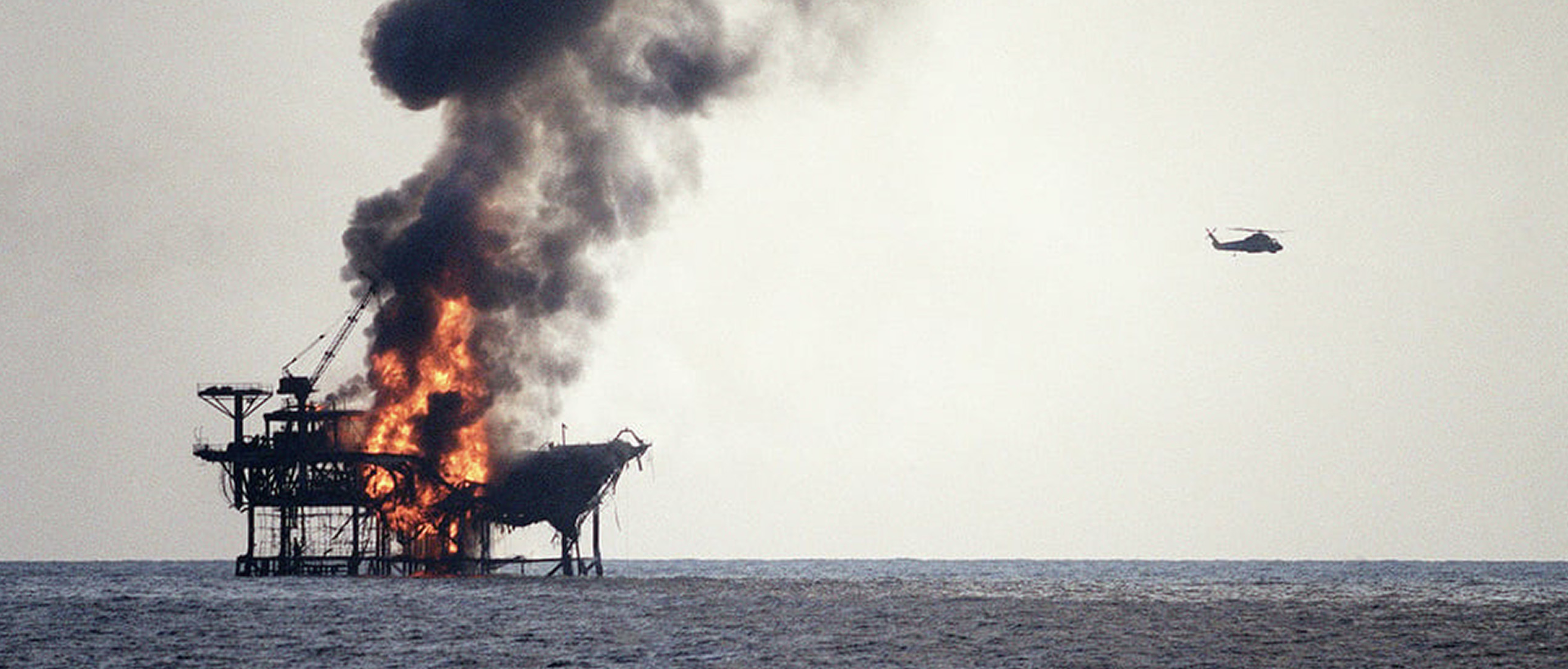
In the end, it was a brief American intervention that shifted the balance. Iraq’s purchase of advanced weaponry was financed by the Gulf states, and their oil had become a target for IRGC mines and Katyusha-armed speedboats. On 18 April 1988 the US Navy carried out Operation Preying Mantis, a one-sided engagement that destroyed two Iranian frigates, two oil terminals used for military surveillance and many speedboats.
Within months, an exhausted Iran relented. In July 1988 Ayatollah Khomeini “drank the poisoned chalice” and accepted UNSCR 598, bringing the war to an end. For the Gulf states, there followed a long period in which their oil trade faced no comparable threat. Iraq, on the other hand, was straddled with a war debt of $100 billion, $37 billion of which was owed to Gulf states.
It was largely the dispute between Iraq and its Gulf creditors, mainly Kuwait, that caused Gulf War I in 1990-91.
Frontline states
What distinguishes the Iran–Iraq war from the latest effort by a regional power (Israel) to weaken – or even topple – the Iranian regime is the extent of direct American involvement. Yet for all their technological sophistication and firepower, America and Israel face much the same strategic challenge as Iraq once did: Iran’s capacity to respond to economic warfare; and to absorb human losses and replenish them, even at the level of senior command.
Perhaps the most striking difference, from a regional perspective, between the Iran-Iraq war and the present conflict is the frontline role now assumed by the Gulf states. For decades their strategy rested on two pillars: reliance on American protection, and the financing of anti-Iran actors in more distant theatres – north or south – so that any fighting remained ‘over there’ rather than at home.
The consequence was that Iraq in 1980-88, and again post-2003 invasion (Gulf War II) with the Sunni insurgency, Syria post-2012 and Yemen post-2014 became war zones. Half a million soldiers died in Iraq's war with Iran; Syria and Yemen suffered similar losses in their civil wars. Now with the war aims of Israel seemingly nothing short of regime change, the battleground has naturally shifted to the Gulf, domination of which has always been the Holy Grail for Iran’s rulers, Shahs and Ayatollahs alike.
Knowing this, the Gulf states have generally sought amicable relations with Iran while also buying security. In the prelude to the latest escalation, they played a visible role in pursuing a diplomatic resolution. That, however, didn’t stop Iran from targeting energy infrastructure, military assets, and the tourism sector in the UAE, Qatar, Kuwait, Bahrain and Saudi Arabia. According to Al-Arabiya TV, 85 per cent of Iranian missiles and drones targeted the Gulf states rather than Israel, with 48 per cent targeting the UAE alone.
Collateral damage
Iran’s cynical and callous attacks against Gulf states is undoubtedly a blatant breach of international law and constitute an act of war; and the Gulf states have a legal and moral right to self-defence.
It is also part of the long legacy of the ‘tanker war’ and the wider Iran-Iraq conflict, which in many ways established the unwritten rules governing how the Gulf serves the world’s energy needs today. The first was set by the US: it would act as the ultimate guarantor of maritime security. The second was set by Iran: if one party cannot use the Gulf, then no one can.
With American and Israeli forces now enjoying air superiority, attention is once again turning to Iran’s oil and gas – exactly as US generals had proposed to Iraq in the 1980s. Yet threatening Iran’s energy infrastructure is only credible if the energy infrastructure of America’s regional allies can be protected in turn. In an era of Shahed drones, that assurance is far from certain. Even with interception rates of up to 96 per cent in some cases, the drone will get through.
Given this, the Gulf Arab strategy based on avoidance is becoming harder to sustain. The US will almost always prioritise Israeli interests over Arab ones; the Iran-Israel war – “Gulf War III” – and the resultant difficulties the Gulf states now find themselves in is the direct result of that misguided policy.
MAED
Opponents of a robust Gulf response to Iranian aggression will point to the possibility of mutually assured energy destruction (MAED). This is the point at which Iran goes after everybody else’s energy and other crucial infrastructure in the full knowledge that its own will also be destroyed. This is certainly a possibility, but if the lesson of the Iran-Iraq war is anything to go by, such a suicidal eventuality seems unlikely.
Despite the wide publicity that attacks on oil tankers received in the 1980s, the use of air power to attack energy infrastructure (as opposed to ships at sea) remained highly selective and restrained. At no point in the war was Iran or Iraq not able to extract, process and export oil. Major Berqquist explains:
Both sides [Iraq and Iran] have strategic assets which they do not want destroyed, that is oil. But their oil cannot be defended adequately since it lies so close to the enemy and since it is a very soft target. Refineries and storage areas can be heavily damaged by strafing, and tanker captains are loath to risk their ships if there is a serious prospect they may be attacked. Since neither side can defend its strategic assets, both must deter the other from striking them. Both the [Iraqi] IQAF and the [Iranian] IIAF serve primarily as a deterrent to the other's ability to strike at strategic targets.
Iran is targeting Gulf energy infrastructure because deterrence has failed: it calculates (correctly) that Donald Trump will not risk soaring fuel prices and a global recession merely to avenge the Gulf states. Israel, for its part, may be willing to stoke the conflict but is unlikely to come to the Gulf state’s aid. The wider Arab world, exhausted by its own Iran-related wars, is in no position to help even if it wanted to.
For peace to return, the Gulf states need to establish their own deterrence, and that means greater confidence and self-reliance in defence.
The Gulf states already have air forces and navies – and in the case of Saudi, also ballistic missiles – far superior to anything Saddam possessed. The UAE has a capable military that could re-assert claims to the islands of Greater Tunb, Lesser Tunb and Abu Musa, occupied by Iran since 1971, as a proportionate response to attacks on its cities by thousands of missiles and drones.
The question for the Gulf states is whether they remain collateral damage, or demonstrate that they are not to be trifled with. It's a confrontation they never wanted, and there will undoubtedly be a cost, but in the long-run establishing deterrence will reap its own rewards, whoever ends up ruling a future Iran.