What Syrians really think
Lessons from 2,700 interviews about fear, disillusionment and public opinion after Assad
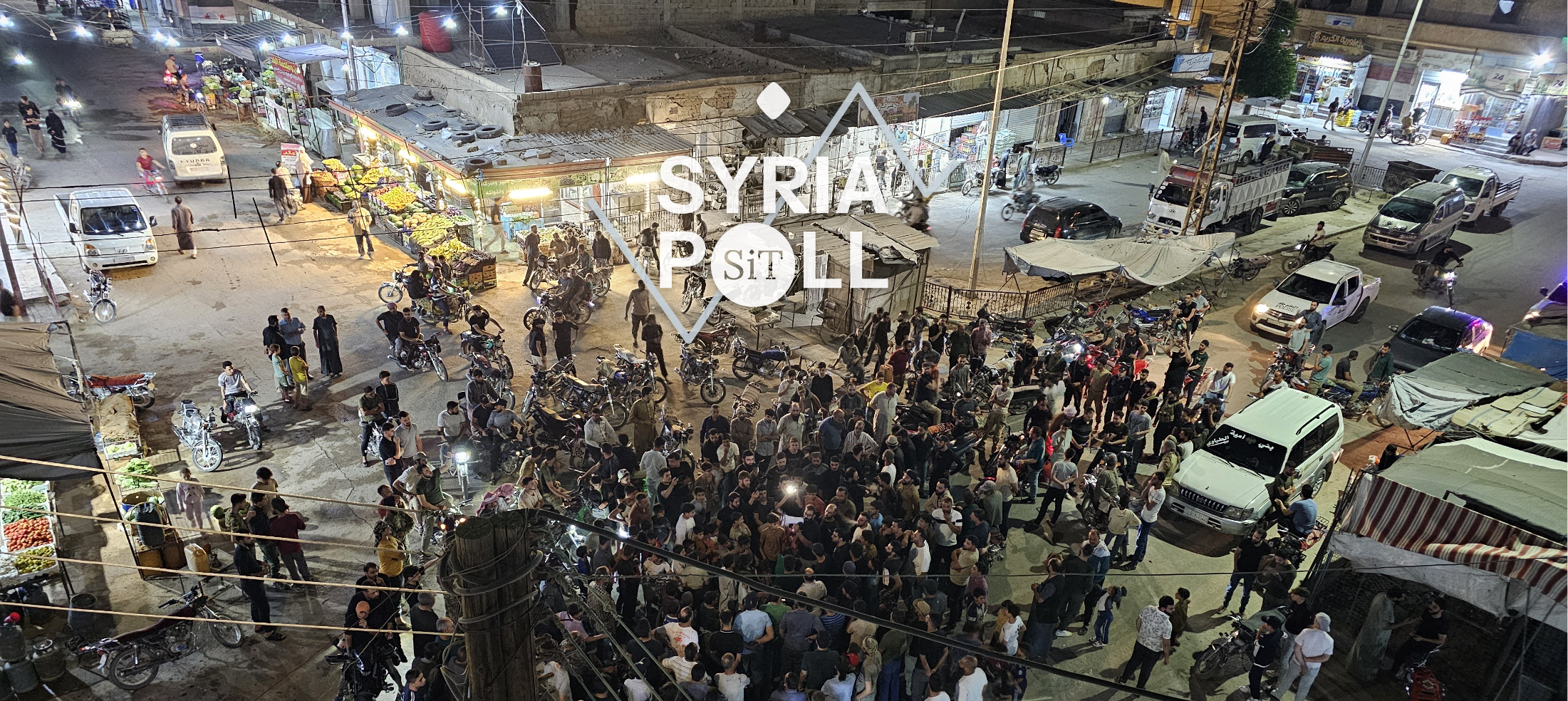
Polling in Syria is, to quote Forrest Gump, like a box of chocolates: “You never know what you’re gonna get.” It can be amusing, when a grandfather approached by a pollster raised his hand and, in a strangely democratic manner, called over all his friends to approach the survey as a group vote. It can be heartening, when people are visibly excited to express their political views openly after decades of no one caring what they thought. It can also be frightening, when a shootout suddenly erupts in the street – and curious, when the interviewee casually, and apparently unfazed, nevertheless continues answering the questionnaire.
In Assad’s Syria, where public adherence to prescribed opinions was an expected performance of loyalty, genuinely capturing and publishing public opinion was a cardinal sin. Syria Poll, launched in February 2026, is the first attempt to establish a regular public opinion survey for a broad audience that captures Syrians’ views on politics, society and economics. It is possible only because Assad has fallen. But the wall of fear his regime created is still there. Many Syrians continue to fear the proverbial ears in the walls despite the dismantling of the mukhabarat. Sometimes it is very obvious, for example when people immediately walk away once political questions are asked. Sometimes it is more complex and potentially more damaging to the authenticity of the results, for example when respondents switch into telling interviewers what they think they are expected to say. And sometimes political or sectarian loyalty shapes responses quite consciously. A person may be fiercely critical of the authorities before the interview begins, only to start praising them once the questionnaire starts because, as some openly explain, they “do not want to give Assad supporters any ammunition.” It is an authoritarian legacy that will take time – and new experiences of trust and safety – to overcome.
Behind the numbers
Running a regular poll during this transitional period is a research project in its own right. The process of polling people on the street tells much about political and social life in Syria, particularly on how opinion is formed, expressed and concealed in conflict and post-conflict environments. There are various established polling methods designed to reduce the effects of fear and self-censorship, for example, by asking sensitive questions indirectly or allowing respondents to conceal their individual answers while still enabling identification of broader patterns in public opinion. Ultimately, however, they all depend on a basic degree of trust: that the interviewer is not an informant, that no one is listening in and that engaging with a pollster will not have negative consequences. Many Syrians, understandably, do not have that trust. Social scientists are well aware of the limitations of survey research, but polling also appears to offer something the social sciences usually don’t produce: clean numbers. For disciplines that sometimes suffer from a bit of an inferiority complex toward the natural sciences – the “real sciences” that produce hard data rather than competing perspectives – polling results can be particularly seductive.
Polling results are particularly attractive because they transform complex attitudes into apparently precise numbers. Outside academic research, polling data is generated and used by government administrators, political campaigns, advocacy organisations and businesses. Both clients and audiences usually want clear answers. The numbers, however, can hide as much as they reveal: it can often be uncertain whether respondents understood a question as intended, why they chose one answer over another, and whether they felt comfortable saying what they really thought. Even with careful methodology and good intentions, producing representative and interpretable survey data is difficult. This is why Syria Poll complements its surveys with regular focus group discussions.
In the June wave, one question asked whether Syrian schools should teach democratic values. Many respondents were unfamiliar with the term “democracy” or had very different associations with it. One woman immediately asked, somewhat indignantly, whether this would mean that her son would start disobeying his parents at home. In the same wave, we asked whether the government had handled SDF integration well, offering “yes”, “no” and “don’t know” as response options. Both the face-to-face interviews and a focus group made clear that many people understood “don’t know” to mean that they lacked sufficient information about what was happening in the northeast, rather than that they knew what was happening but had not formed an opinion. Discussing such details in focus groups helps us improve the way we ask questions and, just as importantly, interpret the answers.
Limited bandwidth
Notably, the lack of information about developments in the northeast did not seem to bother people much. That has much to do with the limited bandwidth people have for politics that does not feel immediately relevant to their acute economic circumstances. During the first wave of Syria Poll in February, optimism about the government and the country’s trajectory was high – 63 per cent said the country was moving in the right direction. Salaries had just been increased, the currency was stabilising, and many expected Syria’s new leadership to transform the country into “the Switzerland of the Arab world” within months. People were excited to talk. By the April and June waves, however, the atmosphere had changed. Electricity prices had increased dramatically, a gas shortage had spread across the country, and confidence in the government’s commitment to transitional justice had begun to erode after Assad family-linked business magnate Mohammad Hamsho and abusive former militia commander Fadi Saqr appeared to avoid accountability. Mounting frustration and economic pressures decreased interviewees’ and focus group participants’ willingness to engage on political questions. The earlier excitement about being able to talk openly about politics increasingly gave way to cynicism, a well-established coping mechanism.
Disillusionment is particularly pronounced amongst respondents aged 18 to 24. Many said they wanted to emigrate, and showed little interest in political questions, focusing instead on finding a future beyond what they increasingly regard as a lost cause at home. Amid economic hardship, people’s political horizons tend to shrink toward the immediate questions of electricity, fuel, jobs and basic services. Politically, this is concerning. If basic service delivery becomes the principal standard against which governments are judged, those in power have greater room to push questions of human rights, accountability and political participation off the agenda. When we asked respondents in June about the People’s Assembly – Syria’s parliament – many were not even aware that it existed. Only 10 per cent believed it would actually influence government decisions.
Yet demands for dignity and justice that underpin political questions cannot be silenced completely. During one focus group, a young man living in poverty said that he did not want electricity, but progress on transitional justice so that he could finally have a grave at which to mourn relatives who remained missing. Another said “People today may be able to endure issues like gas and water… but they cannot endure their pain being ignored.”
Three takeaways
After three waves of Syria Poll, three findings stand out. First, Syrians have become increasingly critical of the country’s trajectory, with 46 per cent expressing a negative assessment in June. “The country is like a bomb; once the fuse is lit, it will explode,” a woman warned in a focus group. Government approval ratings have fallen in parallel, to just 20 per cent. Second, there is a striking gap between high- and low-income areas in assessments of government performance, public services, safety and the rule of law. “Syria has become two classes: one very high, and one under the ground,” another women said. In the June wave, fewer than 10 per cent of respondents in low-income areas reported feeling safe or experiencing a meaningful presence of the rule of law – dramatically lower than the equivalent proportion in high-income areas. In June, 56 per cent of respondents said they had difficulty covering basic living expenses at least once a month, while 23 per cent experienced such difficulties weekly or daily. The third major finding is that confidence in surrounding transitional justice is fragile. In February, 56 per cent of respondents said they trusted the government to achieve transitional justice. By June, only 28 per cent said that the trial of former security chief Atef Najib – the first of its kind against a senior Assad regime figure – had increased their trust in the justice process.
Syria Poll has only just begun. Future waves will expand geographical coverage and increase the sample size from the present 900 respondents per wave. The growing body of data will allow us to track changes in public opinion over time, and to understand better how citizens are experiencing Syria in transition. Syria in Transition will, as ever, cover the story.