Syria Business Diary – September 2026
Twenty litres in Damascus, billions in Dubai
What was announced, and what reached a microbus driver in Quneitra, a trader and a money changer in Rural Damascus, and a family back from Turkey. Our Business Diary follows Syria’s economy from government announcements and billion-dollar deals to prices, wages and transactions on the ground.
Fuel: prices rise, subsidies lag
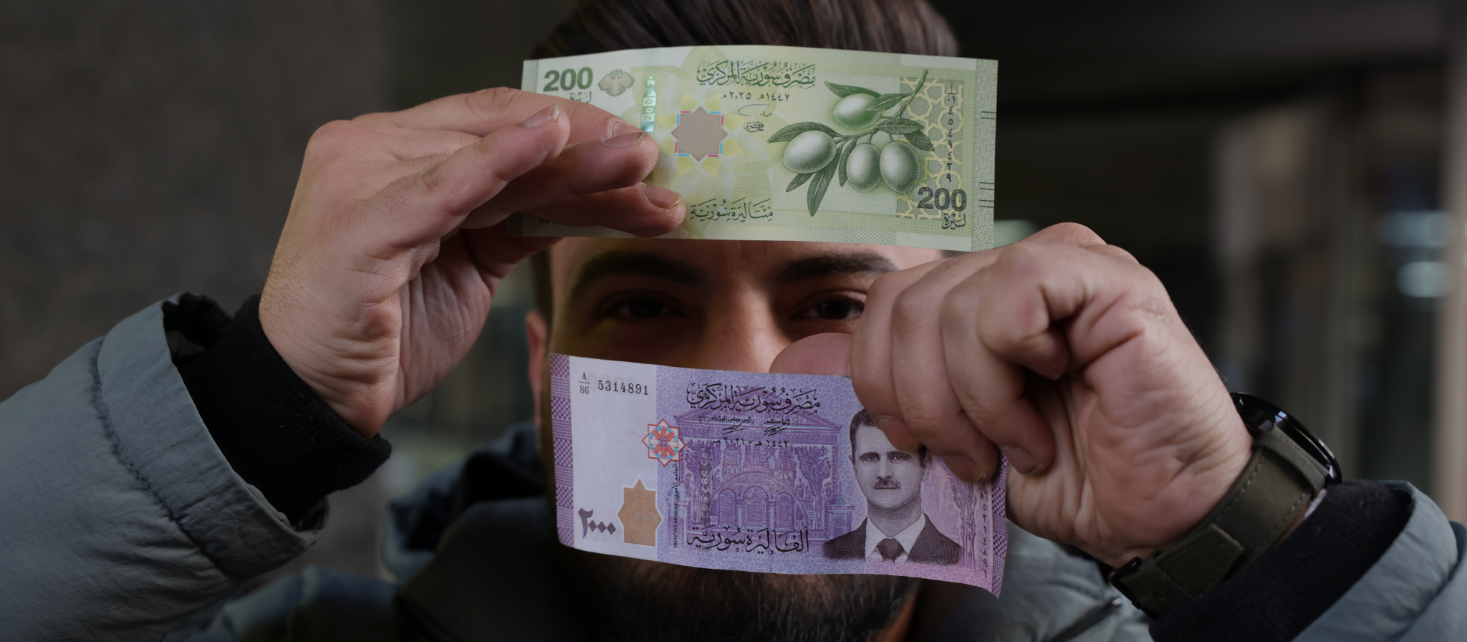
Microbus driver Khaled Mahmoud filled his bus on 29 September with 20 litres of diesel and paid 3,500 new pounds (about $25 at the market rate of roughly 138 pounds to the dollar). He is 64, drives a route across Damascus and commutes from a village in Quneitra. Like most drivers, he still counts in old pounds, which lost two zeros and stopped being legal tender in August. He still thinks of it as 350,000.
"I collect money all day, but none of it reaches my home or family," he told Syria in Transition.
In October 2024, before the Assad regime fell, he paid the equivalent of 100 new pounds a litre. On 13 September this year the new government raised standard diesel from 125 to 175 pounds ($1.27) a litre, and gasoline with it. Four days later, after protestors blocked roads in several governorates, Energy Minister Mohammed al-Bashir announced two cheaper grades: 115 pounds (83 cents) for heating, farming and eligible households, and 150 ($1.09) for transport and other businesses. Neither has reached his pump. A station told him the subsidised grade might arrive within two months, and the government has yet to say who qualifies or for how much.
His fare, set by the transport authorities, has gone from 30 to 50 pounds (36 cents), and he cannot raise it even when tyres, engine oil and repairs cost more. His son's school run costs another 400 pounds ($2.90) a day. He also struggles to make change. The old 500-pound note, printed under the Assad regime, has been withdrawn and is widely refused for small change, he says, and nothing has replaced it.
Winter worries him more. Heating the house takes about 15 litres of diesel a day, 2,625 pounds ($19) at the standard price. Firewood costs about 30,000 pounds ($217) a ton, and the forest reserve outside his village lost more than 100 dunams (10 hectares) of trees to Israeli army bulldozers last October, according to the provincial agriculture director.
"All I can tell my wife is that we and the children must wear our warmest clothes inside the house," he said.
The price rise set off the widest protests since the fall of Assad. More than 50 members of the People's Assembly (Syria’s parliament) summoned the energy minister, and President Ahmed al-Sharaa met energy officials on 16 September, the night before the cheaper grades were announced. The minister appeared before the Assembly on 20 September and set out the import bill. Syria pumps about 112,000 barrels of oil a day and imports another 200,000, at roughly $831 million a month. Self-sufficiency, he said, would come by 2028.
A fire on a gas pipeline near Deir Ezzor, in the east, cut gas to three power plants, including Tishreen outside Damascus, on the evening of 28 September. The Syrian Petroleum Company blamed sabotage. Crews replaced an 18-metre section of pipe and the line was back in service on 2 October. Recent Syria Direct reporting has questioned the quality of repairs at the nearby al-Tabiyah gas plant.
Banking: sanctions lift, barriers remain
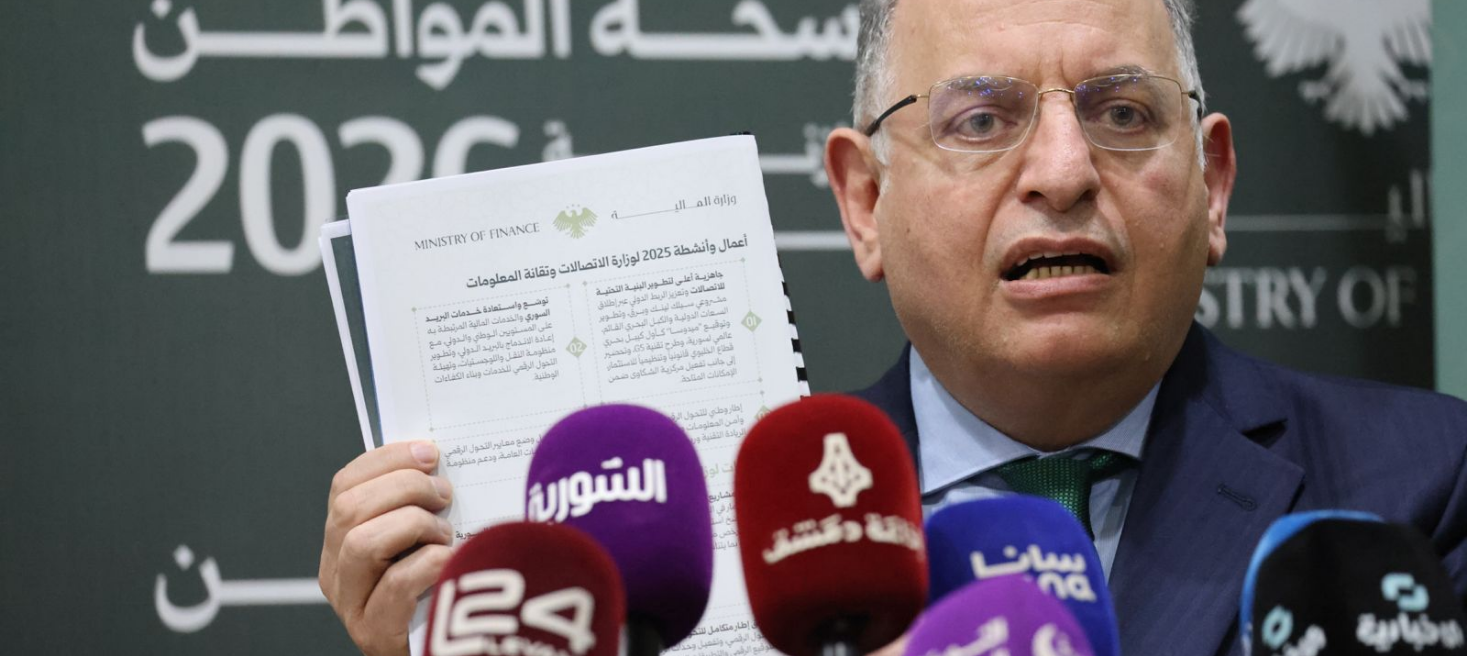
Washington removed the last US sanctions aimed at Syria as a country on 25 September. Sanctions on individuals, including Assad's circle and Captagon traffickers, remain. Central bank governor Mohammad Safwat Raslan said in late September that he expects more than $1 billion in foreign capital for new banks. Seven delegations from the region have shown interest, and each new bank must have a foreign bank as a partner with at least 10 percent.
In the first half of 2026 the government spent about $3.7 billion and took in $2.7 billion in revenue, a $1 billion gap. The presidency told ministries on 28 September to tighten belts by cutting unnecessary spending and deferring investment projects that can wait, sparing salaries and essential services.
Al Baraka Bank Syria, QNB Syria and the state-owned Commercial Bank of Syria signed the country's first joint Islamic loan on 17 September, guaranteed by the government, for two projects: a tunnel beneath central Damascus and a tourist resort on Mount Qasioun. "We cannot rely on the public budget to finance every project," Finance Minister Mohammed Barnieh said.
Syrian banks have no working accounts with major foreign banks, the links needed to make payments abroad, according to the Damascus advisory firm SIMA Partners. Importers cannot routinely open letters of credit at home, and Syrians abroad typically pay 5 to 15 percent to send money home.
Trader Burhan sells electrical components and lighting from a showroom on the edge of Damascus, buying from China and paying in US dollars. He says the lifting of sanctions has made no difference to him. A partner abroad settles his invoices, and Burhan sends him about $30,000 a month through transfer offices. The central bank reconnected to SWIFT, the international payments messaging network, last November, but SWIFT only carries payment instructions. Moving the money needs accounts at foreign banks, which Syrian banks still lack, so he still cannot pay through his own bank. "My greatest hope is for the SWIFT system to be activated as soon as possible," he told Syria in Transition, so that he can pay "directly and officially through my Syrian bank account.”
Muhammad Ibrahim, 40, changes money from a small office in Rural Damascus. On 29 September he was buying dollars at 137.5 new pounds and selling at 138.25, up from about 135 a week earlier. The central bank's rate that day was 122, which he says almost nobody uses. Remittances arrive in dollars, he says, and families take them as dollars or as pounds at the market rate.
His office works through Sham Cash, a mobile payment app, charging 0.3 percent on transfers, and handles public-sector salaries, student fees and service bills. In August, the business site Iqtisadi reported that some offices in Damascus and elsewhere were refusing to pay out Sham Cash balances in cash or charging heavily to do it.
Transfer companies take about two percent to pay out a $200 remittance from Germany or Turkey, he told Syria in Transition, and nine in ten of his customers change the money into pounds the same day, for food, rent and debts.
"Despite the talk about lifting sanctions, the daily volume of remittances remains within normal levels," he said.
Investment: billions meet land claims
While the fuel protests were still running, President al-Sharaa told the Arab Media Summit in Dubai on 15 September that the economy had grown from about $20 billion at the end of 2024 to $32 billion last year and could reach $50 billion this year. The IMF, which says gaps in Syria's economic data limit its assessment, projects real growth above 10 percent. Al-Sharaa pitched the port of Tartus as a trade route that avoids the Strait of Hormuz; DP World has committed about $800 million to it.
The Emirati developer Arada's ‘New Damascus’, announced with the Syrian Sovereign Fund at the end of August, is the largest real estate deal since the war: $7 billion, four million square metres in western Damascus, 11,000 homes and a 700,000-square-metre park, to be built over about a decade.
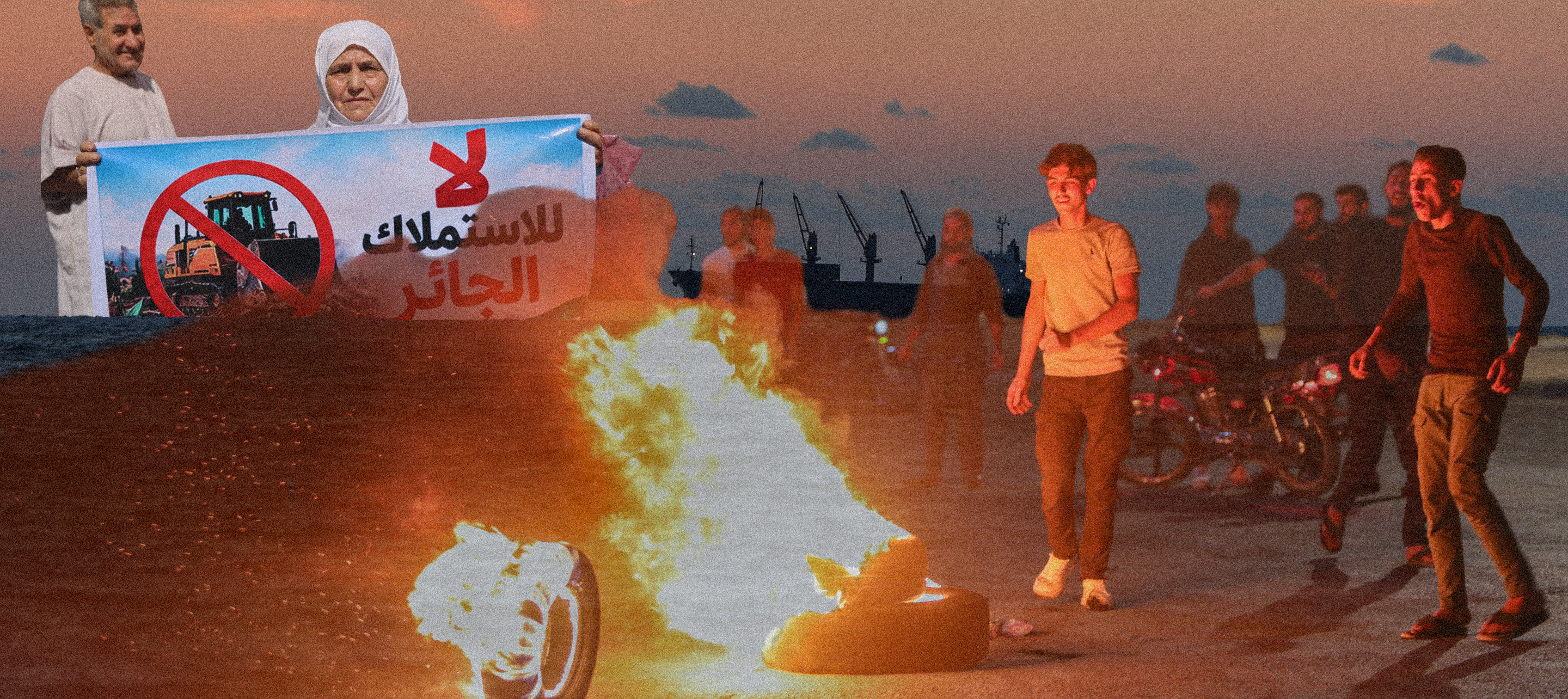
Another mega housing project has faced local resistance. Residents of Qudsaya and nearby towns on the capital's northwestern edge walked onto the site of ‘Abyat Hills’ on 26 September. The Saudi-Syrian project of more than 2,000 homes sits on land they say was expropriated under the Assad regime. They stopped the machinery and held up signs reading "stolen land."
Saudi real estate developer Abyat said it would take legal action over the intrusion and that owners could pursue their claims in court. Two of the landowners spoke to SANA. Mawfaq Abbas, who says about 50 dunams (5 hectares) of his family's land were expropriated, said residents had petitioned the housing ministry and been promised action. Ahmad Ikhtiar, another landowner, said his family had waited since the 1980s without compensation.
Two days after the protests, on 28 September, the General Housing Authority reopened compensation claims under Law 20 of 1983, Hafez al-Assad's expropriation law: cash at the land's value before it was taken, or space in new buildings equal to 10 percent of the land's area, up to 6,000 square metres. The dispute continues.
Returns: more Syrians come home, aid falls short
At the UN General Assembly, Emergency and Disaster Management Minister Raed al-Saleh spoke of moving the displaced out of the camps. "Our goal is not to remove the camps, but to remove the need for them," he told SANA.
More than 1.38 million displaced people have left camps and other displacement sites since December 2024, according to the UN humanitarian office OCHA. About 5.5 million Syrians remain displaced inside the country, a UN expert said in July.
Syrian Airlines began flying to Vienna and Copenhagen on 21 September, after Amsterdam in July and Moscow in August. Returns from Europe are modest. Germany's migration office says its federal return programmes took 2,843 Syrians home in the first half of this year. Austria, which offered voluntary returnees up to €3,000 a head this summer, counted just over 640 departures by the end of July, its interior ministry says.
UNHCR estimated that 1,795,641 refugees had returned since the fall of Assad in December 2024, most of them from Turkey and Lebanon. More went to Damascus than to any other governorate. The agency pays $100 a person before departure and $600 a family after arrival. The arrival grant has reached nearly 100,000 people this year. About 70,000 eligible families are waiting, UNHCR has money for roughly 37,500 of them, and it says it needs another $20 million.
Muhammad Haydar Fathallah, a tiler from Palmyra, came back from Turkey in December 2024 and brought his family of five over in March 2025, at his own expense. A friend who followed later received the $100 on a bank card in Turkey and spent it getting home from the border. His family's house in Palmyra had been destroyed. When he reached Damascus the power was out, the pavements were broken and some neighbours were afraid to leave their homes for fear of the arrests they had known under the old government. He paid $500 a month for a flat in central Damascus, the kind of place he says rented for $100 before the returns began, then moved to the outskirts for $175. He earns about 1,500 new pounds a day, roughly $11.
"Honestly, we feel deep regret over our decision to return," he told Syria in Transition. His advice to Syrians still in Turkey is to stay where they are and keep working.